Short answer
Health anxiety is not about being excessively careful with your health. It is about seeking safety – googling, checking, asking for one more test, asking once more whether it really was normal.
Every confirmation sought gives calm for a few hours and makes the worry stronger over time. That is why the person who has had the most reassurance is often the one who is most afraid.
Symptoms of health anxiety — and what 1177 says
1177 (Sweden's national healthcare advice service) describes it like this: you feel your body and look for signs that you are ill. It is called health anxiety, or hypochondria, and according to 1177 it is common together with generalised anxiety disorder (GAD). So it is not an unusual quirk but a form of anxiety that healthcare recognises.
In everyday life it shows as worry about an illness despite being told that everything looks fine, constant monitoring of the body, googling, repeated questions to other people and visits to healthcare that bring calm for a short while. The anxiety also produces physical symptoms of its own — palpitations, tense muscles, dizziness — that are easily read as yet another sign of illness. That is the chain the next section describes.
According to 1177, health anxiety is treated in the same way as GAD, and cognitive behavioural therapy (CBT) is a form of psychotherapy that works well for many; sometimes it is available online. Contact your local health centre (vårdcentral) or call 1177 if the worry stops you in everyday life. These are descriptions, not a diagnosis — that is made by healthcare.
How it works
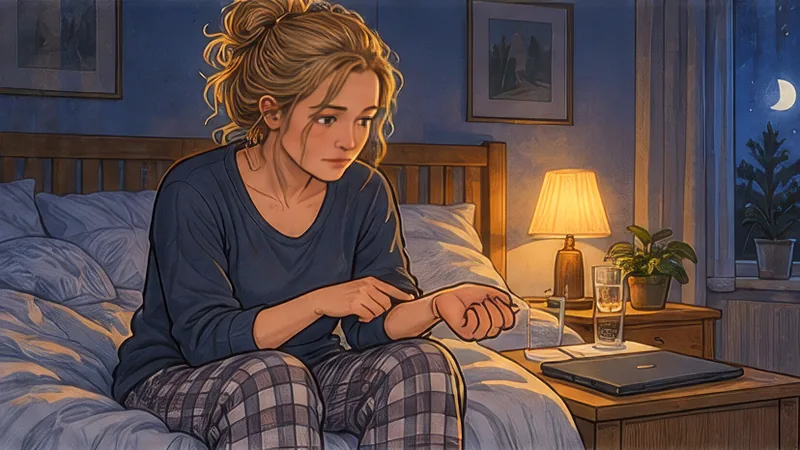
The body is doing things all the time. It clicks, prickles, aches, skips a beat, makes a muscle twitch. No body is silent – the difference between someone with health anxiety and someone without it is not how the body sounds, but what the signal is interpreted as.
The chain is always the same: a sensation is noticed, interpreted as a sign of something serious, and the fear that follows makes the body even more active – which produces more sensations to interpret. Anxiety gives palpitations, breathlessness, dizziness and muscle tension, exactly the symptoms that frighten most.
Then comes what really keeps it going: attention. Someone who decides to watch a part of the body will find something there. This is not imagination, it is how attention works – try focusing on the sole of your left foot for a minute, and suddenly it feels like something.
The safety-seeking that makes it worse
Googling. The search engine always finds the worst explanation, because that is the one most written about. Thirty seconds of searching can give three days of anxiety.
Checking. Pressing the lump, taking your pulse, swallowing to see whether it hurts. The examination also irritates the tissue, so the lump is more tender tomorrow – which becomes a new piece of evidence.
Asking for reassurance. Your partner, your parent, the health centre. The answer helps for a few hours. Then comes "but what if they missed something", and the need is back – bigger.
Avoiding. Hospital dramas, obituaries, a friend's story about her diagnosis. Avoidance confirms that the subject is dangerous.
All four feel like responsibility. In fact they are fuel: they teach the brain that calm came from outside, not from there never being any danger.
What helps
1. Get a proper assessment – once. This matters: health anxiety should never be treated on top of an unanswered medical question. Make sure you are properly examined, and then decide that the answer stands. That decision is the work, not the examination.
2. Stop seeking safety, step by step. Not everything at once. Start with whatever is easiest to let go of – perhaps the googling – and keep it up for two weeks. The anxiety rises first and then falls. It is the same mechanism as in all exposure.
3. Agree with the people close to you. Ask them not to answer "do you think it is serious?". It sounds harsh and it is a kindness: every reassuring answer they give keeps the pattern alive. Work out the wording together, in advance, when things are calm.
4. Postpone rather than resist. "I can check this at 6 pm" is easier than "never". Often the urge has passed by the time six o'clock comes.
5. Change the question. Not "is this dangerous?" but "what do I want to do with the evening, with this feeling still in my body?". The aim is not certainty – that cannot be had – but being able to live without it.
Important: new symptoms should be assessed
This article is about worry that continues after a reasonable medical assessment has been made. New or changed symptoms should always be assessed by healthcare – start with 1177 (Vårdguiden, Sweden's national healthcare advice service), and call 112 if it is an emergency.
According to 1177, health anxiety is treated in the same way as generalised anxiety disorder, and CBT (cognitive behavioural therapy) is a form of psychotherapy that works well for many. You can ask for it through healthcare. Coaching is not treatment.
How I work with it
In personal coaching we begin by mapping the safety behaviours – most people find there are more of them than they thought – and let them go one at a time, with follow-up every week. In parallel we work on what the anxiety has eaten into: the sleep, the plans, the evenings that went on checking.
If it is connected to panic attacks, there is a separate article on panic disorder, and the rumination that keeps the mind going at night is described in sleep and anxiety.
The most important thing
If you take only one thing with you: you will never google your way to safety. Certainty about your own body does not exist, and the hunt for it is the symptom itself.
What you can get is something else, and better: that the body sounds the way it always has, and that you no longer need to know why.
Best wishes, Mikael GlännströmWellbeing coach, author and father of two