Short answer
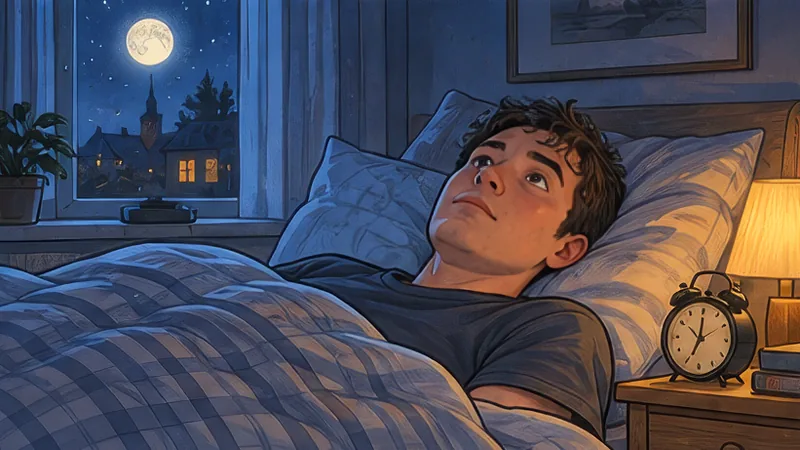
Waking at three and not being able to get back to sleep is not a sign that something is wrong with you. It is what happens when worry and sleep get stuck in a loop: you sleep worse because you worry, and you worry more because you sleep worse.
What breaks the loop is rarely more sleep. It is not lying awake in bed, keeping the same getting-up time every day, and moving the worry to another time of day when you can actually do something about it.
Can't sleep because of anxiety — what 1177 says
It is common not to be able to sleep when you are worried. According to 1177 (Sweden's national healthcare advice service), worry and anxiety can make it hard to sleep, and 1177 recommends seeking help if your sleep problems do not get better even though you have changed your habits to sleep better. You can then contact a health centre (vårdcentral) or apply for treatment at internetpsykiatri.se.
The treatment that 1177 recommends first for long-term sleep problems is cognitive behavioural therapy, CBT. It is also what the section "What actually works" further down builds on. Some health centres offer CBT online for worry, anxiety, stress and sleep, but what is available differs between regions and clinics, so ask your health centre or call 1177.
Anxiety at night can also be a sign of something that needs to be assessed. What applies then is in the box "When it is healthcare that applies" further down, together with the crisis numbers.
Why three o'clock in particular
Sleep runs in cycles, and the closer to morning, the lighter it becomes. The last third of the night is therefore the easiest to wake from — completely normal, and something everyone does several times a night without remembering it.
The difference between someone who sleeps well and someone who doesn't is not the waking. It is what happens in the seconds after. Someone who sleeps well turns over and drifts off again. Someone with high background worry gets the thoughts going straight away — and at that moment the body is no longer on its way to sleep. It is on alert.
Night-time thoughts also have a quality that makes them particularly unhelpful: they feel true. At three in the morning there are no proportions, no counter-arguments and no way to do anything about it. The same worry at ten in the morning is usually just a point on a list.
The loop that keeps it alive
What turns a temporary sleep problem into a lasting one is almost always what you do to fix it.
You go to bed earlier to catch up. The result is more hours awake in bed, and your brain learns that bed is a place where you lie awake.
You stay in bed trying to fall asleep. Effort is the one thing that reliably doesn't work — sleep is not an action, but something that arrives when the body is left in peace.
You sleep in at the weekend. It gives you a mini jet lag of a couple of hours and makes Sunday night worse, which makes Monday worse.
You start monitoring. Checking the clock, counting hours, measuring with the watch on your wrist. Monitoring is in itself a wakeful behaviour, and someone who knows exactly how badly they slept carries it with them all day.
What actually works
This is the core of CBT for insomnia, which is the treatment with the best evidence — better than sleeping tablets in the long run.
1. The same getting-up time every day. Even after a bad night, even at weekends. Getting-up time is the only lever that controls the whole body clock, and it is more effective than anything else on this list.
2. Get up if you have been awake for about fifteen minutes. Go to another room, do something undramatic in dim light, and go back when you feel sleepy. It feels counterproductive and isn't: you are relearning the link between bed and sleep.
3. Bed is for sleep and sex, nothing else. No phone, no emails, no series, no planning tomorrow.
4. Shorten the time in bed. If you lie there for nine hours and sleep six, cut back to seven. Sleep becomes denser and deeper, and once it is stable the time can be extended again. This is the most effective and the most uncomfortable step — do it with support if you can. Don't do it on your own if you have bipolar disorder or epilepsy, if you drive or work with machinery, or if you are low in mood. In those cases CBT for sleep problems is the right route, and you can get it through the local health centre (vårdcentralen) or 1177 (Sweden's national healthcare advice service).
5. Give the worry a time of day. Fifteen minutes in the early evening with paper: what am I worried about, what can I do about it, what is the next concrete step. It sounds too simple to work, and yet it is often what stops your mind reopening the case at night.
6. Light in the morning, less in the evening. Ten minutes of daylight early on does more for your body clock than most evening routines.
What helps less than people think
Sleep apps and rings. Tracking data makes most people more awake, not less. There is even a name for the phenomenon — becoming obsessed with perfect sleep makes sleep worse.
Alcohol. You fall asleep faster and sleep worse in the second half of the night. It is one of the most common causes of waking at exactly three.
Making up for it with naps. A short nap early in the day is fine. Two hours in the afternoon borrows from the night.
When care is what's needed
If the sleep problems have lasted more than three months, or if you snore heavily and are tired despite whole nights, it should be assessed — sleep apnoea and other conditions are not treated with routines. Start at the local health centre or 1177.
The same applies if the insomnia is linked to low mood, anxiety that limits your everyday life, or thoughts of not wanting to live. Coaching is not treatment, and 112 is the number for emergencies. If you are having thoughts of not wanting to live: call Självmordslinjen 90101 (Mind's suicide helpline), open around the clock, or chat via mind.se.
How I work with it
Sleep rarely comes up as the main issue in coaching — it comes as something that is 'also' bad. Often it turns out to be the thread that holds the rest together: someone who has slept badly for half a year has less margin for everything else, and the tools that would otherwise work become heavier to use.
We therefore almost always start with the getting-up time and the worry slot, because they are the cheapest to introduce and show results first. If the worry is linked to anxiety, there are separate articles on panic attacks and emotion regulation, and the chapter Focus on the present in the book covers the same rumination from another angle.
The most important thing
If you only take one thing with you: stop trying to sleep. It is the only task in life where effort is guaranteed to be counterproductive.
Decide when you will get up, get out of bed when you are lying awake, and give the worry its own time of day. The rest usually follows — not in one night, but within a few weeks.
Kind regards, Mikael GlännströmWellbeing coach, author and father of two