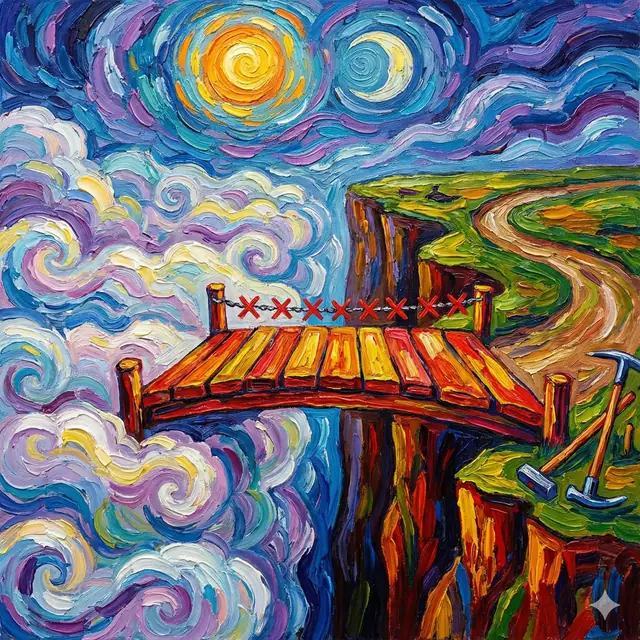
“Vision without action is a daydream. Action without vision is a nightmare.” – Japanese proverb
Now that you know why you are here and what you want, one question remains that gets most people stuck: how are you actually going to get there?
In theory the answer is ridiculously simple. Want to stop drinking Coca-Cola? Stop buying it. Want to get in shape? Move. If logic were all it took, nobody would smoke, everyone would have a pension savings plan, and nobody would procrastinate.
But we are not robots. We are biological beings steered by emotions, habits and surroundings. In psychology this phenomenon is called the intention–behaviour gap – the gap between what we intend to do and what we actually do (Sheeran & Webb, 2016).
Bridging that gap is not a matter of “pulling yourself together”. It is a matter of strategy.
It isn't laziness – it comes down to variables
When you fail at a “how”, it is seldom your character that is at fault. It is your analysis of the situation. The answer to how you succeed depends on three factors:
1. Your biology and psychology
Are you rested or exhausted? Do you have a brain that constantly seeks dopamine (as is the case in ADHD, for example), or a brain that is driven by a sense of safety? If you want to stop eating sugar but use it to dampen anxiety, then giving up sugar is not a question of diet – it is a question of emotional regulation.
2. Your environment (context)
The behavioural scientist Kurt Lewin argued that behaviour is a function of the person in relation to the environment (Lewin, 1936). If you want to start exercising but have three small children and a demanding job, the problem is not lack of motivation. The problem is logistics.
3. Your resources
Do you have the knowledge? Do you have the time? Do you have the energy? Trying to run a marathon without a training programme is not ambitious; it is reckless.
The chain of action – Seinfeld's strategy
One of the best-known examples of a concrete “how” comes from the comedian Jerry Seinfeld. When he was young and wanted to become a better writer and comedian, he realised that he needed to write jokes every day.
His method was analogue and mundane. He hung a large wall calendar. For every day on which he wrote a joke, he drew a big red cross over that day. After a few days he had a chain of crosses. His only goal then became: don't break the chain.
He did not focus on the result (becoming a star, writing the perfect joke). He focused on the process (write every day).
The author James Clear, who wrote Atomic Habits, argues that we do not rise to the level of our goals, but fall to the level of our systems (Clear, 2018). Your “how” is your system.
From thought to action
To succeed we have to stop guessing and start planning for reality. We have to foresee the obstacles before they appear. Research shows that so-called implementation intentions (“If X happens, then I will do Y”) dramatically increase the chance that we actually carry out a change (Gollwitzer, 1999).
Let us build your bridge across the gap.
Exercise
Your how-strategy
Purpose: To break your goal down into a concrete action plan that holds even when motivation runs out. We use principles from behavioural activation and implementation intentions.
Step 1 – Define the concrete behaviour
Look back at what you wanted in the previous chapter. What do you physically need to do? Be specific. “Eat healthily” is an opinion. “Eat a carrot with lunch” is a behaviour.
- Write down: What will you do? When will you do it? Where will you do it?
Step 2 – Identify the obstacle (the WOOP method)
What is going to stop you? (Because something will.)
- Is it lack of time?
- Is it sugar cravings?
- Is it the mobile phone?
Theory: By visualising the obstacle in advance (mental contrasting), you prepare the brain to solve the problem (Oettingen, 2012).
Step 3 – Create an “if–then” plan
Now we are going to write an algorithm for your brain.
- Formula: “IF [obstacle arises], THEN I WILL [do this alternative action].”
- Example: “IF I am too tired to go to the gym, THEN I WILL go for a 10-minute walk instead.”
- Example: “IF I feel like sweets, THEN I WILL drink a large glass of water first.”
Step 4 – Minimise resistance (Tiny Habits)
Make the behaviour so small that you cannot say no. The researcher BJ Fogg calls this Tiny Habits (Fogg, 2019).
- If you want to read more: read one page.
- If you want to exercise: do one press-up.
- Your task: what is the absolute smallest version of your goal?
Step 5 – Log your week
Over the next seven days, keep a simple log.
- What did I want to do?
- What did I actually do?
- What prevented me (if I didn't do it)?
This increases your self-awareness and gives us data to adjust your strategy with. Over time you become more and more aware of the process and of what works and what does not. Don't be afraid to ask for help or to talk the process through with someone you trust.
References (6)
- Clear, J. (2018). Atomic habits: An easy & proven way to build good habits & break bad ones. Avery.
- Fogg, B. J. (2019). Tiny habits: The small changes that change everything. Houghton Mifflin Harcourt.
- Gollwitzer, P. M. (1999). Implementation intentions: Strong effects of simple plans. American Psychologist, 54(7), 493–503.
- Lewin, K. (1936). Principles of topological psychology. McGraw-Hill.
- Oettingen, G. (2012). Future thought and behaviour change. European Review of Social Psychology, 23(1), 1–63.
- Sheeran, P., & Webb, T. L. (2016). The intention-behavior gap. Social and Personality Psychology Compass, 10(9), 503–518.
Want the book in your hands?
The whole of Välmåendecoach can be read here. The printed, signed edition is also available — and it can be read on the sofa without a screen.
The road there is easier with someone holding the map. Here is how coaching works.