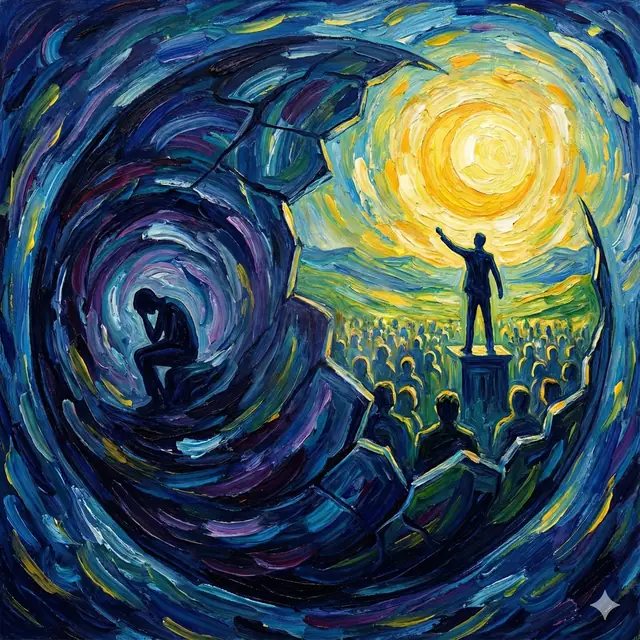
“It is not what happens to you, but how you react to it that matters.” – Epictetus
I want to share my own journey. Not to seek sympathy, but to offer hope: there are ways out of suffering.
In my twenties I developed severe social anxiety. I often describe my life during that time as a bubble that kept shrinking. It grew smaller and smaller every day, until one day it burst. Things that were everyday events for other people – making a phone call or bumping into an acquaintance in the street – became, for me, events that brought on severe anxiety.
I ended up in a downward spiral of depression and panic disorder. My self-esteem was wiped out, and the future felt not just dark but non-existent. For six years I lived in this state of isolation before I began to find the tools to break the pattern.
Today I live a life that once felt like a utopia. I have a family, friends and work I love. I regularly stand on stage giving talks – an activity that twenty years ago would have been my worst nightmare. I feel well; not every second, but on the whole. The anxiety is more or less gone.
The three-dimensional explanation
Many people ask what made the difference. The truth is that it is never down to a single event. To understand human suffering and recovery, we need a broader perspective. In psychology this is called the biopsychosocial perspective (Engel, 1977).
The model holds that our wellbeing is shaped by three interacting levels:
- Biology: We are born with different starting points. I have an inherited vulnerability to anxiety and live with ADD, which affects how my brain processes stress and reward.
- Psychology: My lack of tools for handling the responsibilities of adult life and its setbacks created destructive patterns of thought.
- Social environment: The absence of work, routine and a meaningful context fed my isolation.
Well-known examples of the interplay
We see the same pattern among public figures who have chosen to be open about their ill health. The singer Lady Gaga has described how her chronic pain and mental health problems are the result of both trauma (psychology/environment) and genetic factors (biology). The actor Stephen Fry has, in a similar way, shown how his bipolar disorder calls for a combination of medical understanding (biology) and a way of life that supports his wellbeing (environment).
Just as for them, it took efforts on all three levels for me to turn the trend around: the right kind of medication for my brain, new psychological tools for facing my fear, and building a sustainable social environment through work and relationships.
The biopsychosocial perspective reminds us that there is rarely a single cause of feeling unwell – but it also means there are several different routes to feeling better. And that what works is very individual. That is why this book contains 30+ exercises rather than just one.
Exercise
Your biopsychosocial map
Purpose: To map your wellbeing from a whole-person perspective, in order to identify new opportunities for change. This is an evidence-based method for moving from a feeling of being “broken” to understanding the factors that affect you (Brakemeier et al., 2014).
Step 1 – Choose a focus area
Choose an area of your life that feels difficult or draining right now (e.g. stress at work, a relationship or your general energy levels).
Step 2 – Map your factors
Divide your situation into the following three categories:
- Biological factors:
- What does your sleep, diet and physical activity look like?
- Is there any heredity or medical condition (e.g. neurodevelopmental conditions such as ADHD and autism, NPF) that plays a part?
- Psychological factors:
- What patterns of thought or fears come up?
- What strategies do you use to deal with discomfort (do you avoid it or confront it)?
- Social & environmental factors:
- What does your support network look like?
- Are there sources of stress in your home, your finances or at your workplace?
Step 3 – Look at the whole picture
Look at your map.
- Which factors are you best placed to influence right now?
- Which factors do you need to accept as they are?
Step 4 – The small step
Choose one factor from any of the three categories where you can take a small step today.
- Example (Biology): Go to bed 30 minutes earlier.
- Example (Psychology): Notice when a self-critical thought appears, without arguing with it.
- Example (Social): Call a friend you trust.
References (3)
- Brakemeier, E. L., et al. (2014). Evidence-based psychotherapy for depression in adults. Psychopathology, 47(3), 152–162.
- Engel, G. L. (1977). The need for a new medical model: a challenge for biomedicine. Science, 196(4286), 129–136.
- Hayes, S. C., & Hofmann, S. G. (2017). Process-based CBT: The science and core clinical competencies of cognitive behavioral therapy. New Harbinger Publications.
Would you like the book in your hands?
The whole of Välmåendecoach can be read here. The printed, signed edition is also available – and it can be read on the sofa without a screen.
Stuck in the bubble? A conversation can be what bursts it.