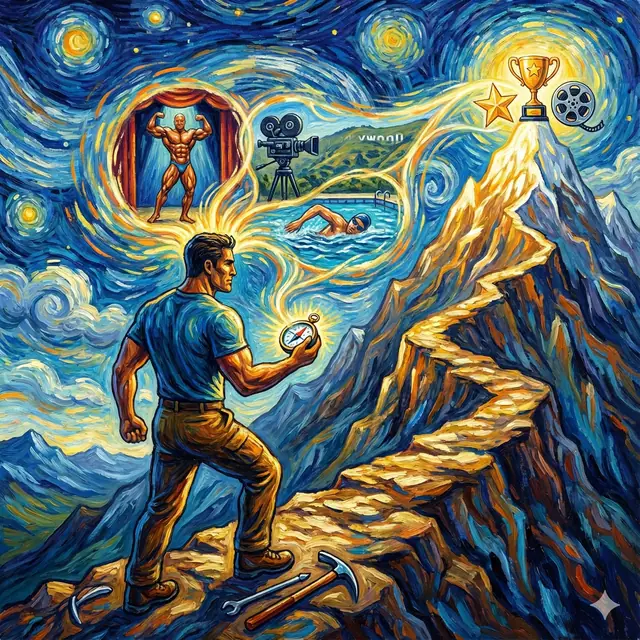
“I see myself at the top before I have even started to climb.” – Arnold Schwarzenegger
When Arnold Schwarzenegger was a boy, he put up a poster of his idol, the bodybuilder Reg Park, on his wall. He decided there and then: he would become a bodybuilder and an actor, just like his role model. At the age of 20 he was one of the most successful bodybuilders in the world.
But his vision did not stop there. Although he barely spoke English, he saw himself as a leading actor in Hollywood. After countless hours of language lessons and an iron will, he stood there as Conan the Barbarian and later as the iconic Terminator. He kept redrawing his map – he became a comedy actor, governor of California and one of the most influential people in the world.
Arnold is not unique in his method, but he is one of the clearest examples of the power of visualisation: the ability to create a mental picture of a reality that does not yet exist, and then to act until the picture and reality merge.
More than just daydreaming
Visualisation is often confused with passive wishful thinking or pseudoscientific ideas about “manifesting” success by simply thinking about it. But in a serious psychological context, visualisation is a high-performance tool.
It is about creating a clear mental simulation of both what you want to achieve and – most importantly – the steps required to get there. Research in neuroscience shows that the brain activates similar neural pathways when we imagine an action as when we actually perform it (Holmes & Collins, 2001).
From Jim Carrey to Michael Phelps
Arnold is in good company. The actor Jim Carrey, long before he broke through, wrote himself a cheque for 10 million dollars for “acting services rendered”. He carried it in his wallet and every evening drove up to a hill with a view over Los Angeles and imagined how great directors would want to work with him. The cheque was cashed ten years later, to the day.
The swimmer Michael Phelps, the most successful Olympian of all time, used visualisation down to the smallest detail. He called it “watching the video”. Every evening before he fell asleep, he pictured the race from start to finish – including what he would do if his goggles leaked or if his turn did not go perfectly. When the obstacles then appeared in real life, his brain had already solved the problem a thousand times before.
I use a similar method myself. Before giving a talk, I usually run through the script in my head, or even write the script in my head. I play with different sentences and try out different versions. When I finally sit down to write the script, or start speaking, I have already done it several times before.
On some occasions I have even, in my dreams, done things to prepare for future situations.
Your mental GPS
Visualisation works like a mental GPS. If you do not know where you are going, it does not matter how fast you are. By entering the destination into your inner navigator, your brain automatically begins to look for opportunities and resources that line up with the picture.
But a map without feet makes no difference. For visualisation to move mountains, it has to be combined with goal-directed action. It is in the meeting between the inner picture and the outer work that the magic – or rather the results – arise.
Exercise
My goal, my film
Purpose: To strengthen motivation through mental simulation, and to prepare the brain for the concrete actions needed to reach a goal (Taylor & Pham, 1996).
Step 1 – Choose your focus
Formulate a concrete goal for the coming 3–12 months. It should be challenging but realistic.
- Example: “I have given my first talk” or “I exercise three times a week”.
Step 2 – Create the inner film
Sit comfortably and close your eyes. Imagine that you have reached your goal. Make the picture as vivid as possible by answering:
- Where are you? What do you see in front of you?
- How does it feel in your body (pride, calm, energy)?
- What sounds do you hear (applause, silence, birdsong)?
- What are you saying to yourself?
Step 3 – Process visualisation (the most important step)
Rewind the film. See yourself doing the work that is required. See yourself sitting at the computer writing, see yourself lacing up your shoes when it is raining outside. Imagine how you handle resistance and choose to carry on anyway.
Important: Research shows that those who visualise the path to the goal do better than those who only visualise the outcome (Gollwitzer, 1999).
Step 4 – Write down the key scenes
Make a short list in bullet points:
- The final picture: (the goal achieved)
- The work scene: (the daily routines)
- The obstacle scene: (how you deal with a setback)
Step 5 – The daily routine
Replay your film for two minutes every day, preferably as soon as you wake up or before you fall asleep. Always end with the question: “What is one small step I can take today to stay in line with my film?”
References (3)
- Gollwitzer, P. M. (1999). Implementation intentions: Strong effects of simple plans. American Psychologist, 54(7), 493–503.
- Holmes, P. S., & Collins, D. J. (2001). The PETTLEP approach to motor imagery: A functional equivalence model for sport psychologists. Journal of Applied Sport Psychology, 13(1), 60–83.
- Taylor, S. E., & Pham, L. B. (1996). Why thinking about goals and pathways is beneficial. Journal of Personality and Social Psychology, 71(5), 934–949.
Would you like the book in your hands?
The whole of Välmåendecoach can be read here. The printed, signed edition is also available – and it can be read on the sofa without a screen.
Exercises like this one can be done together. Here is how coaching works.