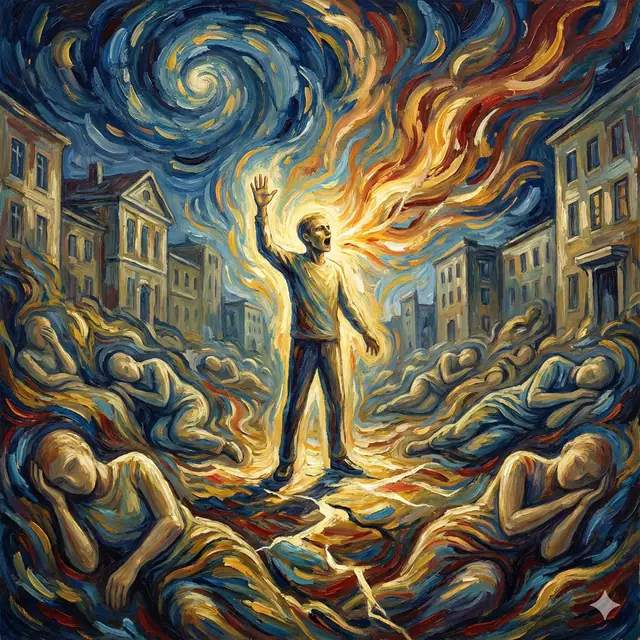
“Our lives begin to end the day we become silent about things that matter.” – Martin Luther King Jr.
Human beings are biologically programmed to choose the easiest path. We conserve energy, avoid unnecessary conflict and gravitate towards whatever demands the least effort. From an evolutionary perspective, this was a brilliant survival strategy in the wilderness. But in a modern, complex society, the same principle can become our greatest weakness.
When comfort becomes the norm, what national economists and sociologists call institutional inertia or social entropy arises. This means a natural decline of structures and functions when no one actively maintains them any longer. Rules become routine, procedures are forgotten and critical thinking falls silent. The system becomes less and less effective.
When systems fall asleep
Take schools or healthcare as examples. Curricula and policies are updated continuously, but the actual structures often change painfully slowly. When resources shrink and administration grows, creativity and the individual's voice are often buried under documentation requirements. Teachers are given more and more to look after, and less and less time for teaching and guiding the children.
This rarely happens because someone wishes harm. It happens because it is convenient not to question things. It is painful to fight for every issue, and without a constant reminder of what matters, quality erodes slowly but surely. If no one protests against an unfair rule or a faulty routine, the shortcoming eventually becomes the new truth.
My ADD means I say exactly what I think. Sometimes that is a good thing and can lead to growth, but sometimes it also comes across a little too confrontational and can lead to conflict. In the end, though, I am glad that I dare to say what I think and fight for what I believe is right.
Voices that move mountains
History has shown that the greatest changes often begin with a single person who refuses to accept that “it's just the way it is”.
When Rosa Parks refused to give up her seat on the bus in Alabama in 1955, she did not merely challenge a seat – she put a spoke in the wheel of an entire segregated system. Her act required no violence, but it required an enormous amount of moral courage. In the same way, Malala Yousafzai showed that a young voice can threaten the most authoritarian regimes simply by asserting the right to education.
These people were not born as revolutionaries; they were people who felt the friction of injustice and chose not to look away. They reminded the world that high standards and human rights are not self-playing pianos – they have to be cared for and defended every day.
Everyday civil courage
Standing up for what is right does not always have to involve world-historical events. Civil courage is often about the small gestures in everyday life: questioning a colleague's exclusionary joke, pointing out unfair treatment at school, or daring to tell a manager when a process is harming people.
If you do not fight for your own and others' rights, you run the risk of them slowly withering away. To be a “reminder” means using your critical thinking and daring to act when your gut tells you something is wrong. It means refusing to let comfort trump morality.
You do not need to change the world every day. But by caring, and by speaking up when it is needed, you counteract social entropy and contribute to a brighter future for us all.
Exercise
Everyday civil courage
Purpose: To train your ability to identify injustice and prepare action in line with your values. Research shows that we find it easier to act morally if we have mentally prepared ourselves for difficult situations (Staub, 2011).
Step 1 – Identify the friction
Think of a situation (real or imagined) where something felt wrong. It could be a colleague who was ignored, an unfair rule, or someone being belittled in a group.
- Describe the situation briefly: What happened?
Step 2 – Analyse the obstacles
What is it that stops us from acting in such a moment?
- Is it the fear of standing out?
- Is it the fear of conflict?
- Is it the thought that “someone else will surely do something”? (This is known as the bystander effect, see Zimbardo, 2007.)
Step 3 – The values compass
Choose two of your most important values (e.g. Fairness and Honesty).
- Ask yourself: “How would I act in this situation if I let these values guide me entirely, instead of my fear?”
Step 4 – Formulate your action
Create an “If–Then” plan for civil courage:
- Example: “IF I hear someone speaking badly about a colleague who is not there, THEN I will say: 'I don't experience that person that way – can we talk about something else?'”
- Example: “IF I see someone being ignored in a meeting, THEN I will ask that person a direct question to give them a chance to speak.”
Step 5 – The mental film
Imagine acting according to your plan. See yourself speaking calmly and clearly. Notice how it feels in your body afterwards. Having done the right thing often gives a lasting strength that outweighs the short-term discomfort.
References (3)
- Bandura, A. (1997). Self-efficacy: The exercise of control. W.H. Freeman.
- Staub, E. (2011). The psychology of good and evil: Why children, adults, and groups help and harm others. Cambridge University Press.
- Zimbardo, P. G. (2007). The Lucifer effect: Understanding how good people turn evil. Random House.
Would you like the book in your hands?
The whole of Välmåendecoach can be read here. The printed, signed edition is also available – and it can be read on the sofa without a screen.
This is one of the topics I talk about. Book a talk.