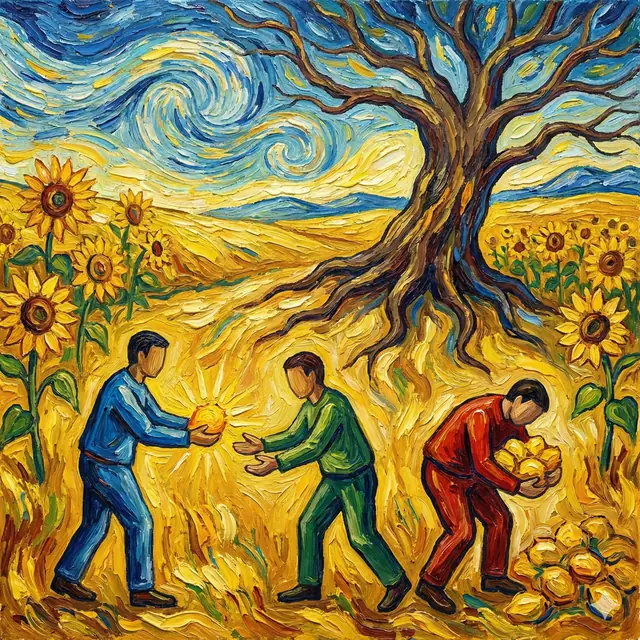
“We make a living by what we get, but we make a life by what we give.” – Winston Churchill
Everything alive moves in cycles. It sprouts, reaches towards the light, blossoms and lets go. Nature does this calmly and consistently. A seed never wonders about its worth. It responds to warmth, water and soil. If the conditions are there, it grows.
The carrot illustrates this with its simple logic. It needs room for its roots, nourishment in the soil and access to water. Given these, it develops. Given too little, the process stalls. No explanations are needed.
Human development follows the same basic principles, only in a more complex form. Our growth moves through relationships, expectations and context. Biology remains in the background, while the direction is shaped by social signals and psychological interpretations.
Effort as a yardstick
In many societies, effort works as a currency. Those who struggle are considered to deserve their place. Those who succeed quickly are often credited with special qualities. Status shifts over time, sometimes linked to the body, sometimes to performance or self-discipline. The pattern is stable: work is expected to lead to reward.
This is where a slippage occurs. Results begin to be read as proof of worth. Success is seen as a character trait. Setbacks as personal failings. The invisible background – access to support, security and timing – fades.
Malcolm Gladwell showed how success grows out of the meeting between the individual and the environment. Talent and effort are needed, but the surroundings determine how far they will take you. Two people can work with the same intensity and still end up in different places. The difference often lies in things like school, network or the context around them.
This is clearly visible in children. Some grow up with adults who pick up on their interests early. Others find their strengths later, sometimes after many years of headwinds. The process says more about the conditions than about the person.
The flow of resources
Time, money, energy and attention work as the building blocks of life. A shortage of any one of them affects the whole system. In everyday life this often takes on a moral colouring. People are described as committed, demanding, self-reliant or passive, even though the same behaviour can arise from completely different circumstances.
A person who turns down an assignment may be protecting their recovery. Another may lack the margins to take the risk. The surface rarely gives the whole picture.
Politics tries to frame structures around this. Some perspectives stress individual responsibility. Others turn the spotlight on equal starting conditions. In practice, most lives move between these poles, day by day, relationship by relationship.
How resources circulate between people
Resources are rarely created on your own. They grow through exchange. A conversation. A recommendation. An opportunity that opens up.
Research shows that people often approach this exchange in different ways. Some focus on what they can get. Others look at what they can contribute. A third group strives for balance and reciprocity.
Those who succeed over time often belong to the third category, or to strategic givers. They contribute generously, while also looking after their boundaries. In this way, relationships are built that can bear strain, and networks that keep working even under pressure.
Benjamin Franklin created such contexts through his discussion clubs. The members shared ideas, contacts and knowledge. Everyone contributed to the whole. Everyone benefited from it. Development arose there that reached far beyond the individual.
Development as balance
A life marked only by taking quickly becomes fragile. A life dominated by giving loses its strength. Sustainable development grows when the flow moves freely between people.
Understanding your own role in this cycle changes your perspective. Relationships become living systems rather than transactions. Success gains depth. Setbacks become understandable.
Nothing thrives for long at someone else's expense. All real development bears the marks of interplay.
Exercise
Relational resource analysis
Purpose: To map the balance in your most important relationships and identify where adjustments are needed between giving, taking and exchanging (Grant, 2013).
Step 1 – Map three relationships
Choose three people you interact with regularly (e.g. your partner, a close friend and a colleague).
Step 2 – Analyse the flow
Answer the following questions for each person:
- What do I give? (Time, listening, practical help, affirmation).
- What do I receive? (Support, energy, knowledge, security).
- Which style dominates? Does the relationship feel like an exchange (a trader), do you mainly feel that you give (a giver), or do you mainly feel that you receive (a taker)?
Step 3 – Identify imbalances
Mark relationships where:
- You give too much: You feel drained of energy and sense that your own needs are not being met (risk of burnout).
- You take too much: You receive a lot of support but notice that you rarely ask how the other person is doing or offer help (risk of guilt or distance).
Step 4 – Restore balance
For each unbalanced relationship, write down one concrete action to restore the balance:
- If you give too much: Practise setting a boundary, or ask for a specific favour in return.
- If you take too much: Plan a time when you give the other person your undivided attention or help.
Step 5 – Long-term reflection
Look at the whole picture. Are you someone people turn to for energy, or are you the one who seeks it? How does your style affect your sense of meaning and your social standing?
References (3)
- Gladwell, M. (2008). Outliers: The story of success. Little, Brown and Company.
- Grant, A. (2013). Give and take: A revolutionary approach to success. Viking Press.
- Trivers, R. L. (1971). The evolution of reciprocal altruism. The Quarterly Review of Biology, 46(1), 35–57.
Would you like the book in your hands?
The whole of Välmåendecoach can be read here. The printed, signed edition is also available – and it can be read on the sofa without a screen.
The balance between giving and taking is rarely obvious. Here is how coaching works.