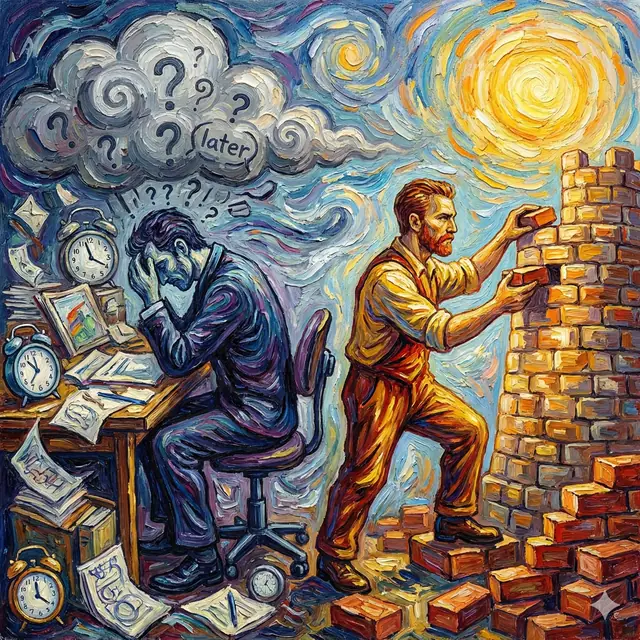
“You cannot build a reputation on what you intend to do.”
– Henry Ford
I recently read a post that described chronic procrastination as one of the most dangerous, yet most underestimated, problems of our time. I cannot help but agree.
In popular culture, procrastination is often glorified as something almost charming. We see memes about how the “superpower” is doing everything the night before a deadline, or jokes about how we work best under pressure. But for someone who carries a constant knot of anxiety in the stomach, and watches their dreams gather dust while the hours slip away in mindless scrolling, it is anything but charming.
The myth of laziness
The first thing we must understand is that procrastination is not about laziness or a lack of character. Research shows that it is in fact about difficulties with emotional regulation (Sirois & Pychyl, 2013). We do not put off a task because we are lazy, but because the task stirs up negative feelings – fear, uncertainty, boredom or self-doubt. To escape the discomfort, the brain chooses the quickest route to relief: doing something else.
When we put something off, we create a temporary reward by escaping the discomfort, but the price is high. Procrastination settles over everyday life like a toxic filter. Everything becomes a little murkier, and our mental energy is slowly drained by all those “shoulds” that we carry around in our subconscious.
From Frank Lloyd Wright to Margaret Atwood
Even the most successful people wrestle with this. The legendary architect Frank Lloyd Wright was commissioned to design the house Fallingwater (one of the world's most famous houses). He postponed the work for nine months. It was not until the client rang to say that he was on his way to look at the drawings that Wright sat down and drew the entire house in just over two hours. It became a masterpiece, but at the cost of enormous stress.
The author Margaret Atwood has described how she sometimes spends whole mornings simply staring out of the window or doing unimportant chores before she can bring herself to write. To deal with this, she has at times used two different desks: one for “play” and one where absolutely nothing but work may take place. Both of them understand that the resistance is not about a lack of talent, but about the fear of not doing the idea justice.
The way out of the circle
Breaking the cycle of procrastination is not about becoming an emotionless robot. It is about understanding the mechanisms behind your avoidance.
- Stop glorifying adrenaline: Working at the last minute is often an escape reaction, not a choice of efficiency. The difference between being efficient and being driven by adrenaline is how you feel afterwards.
- Identify the fear: What are you really avoiding? Is it the fear of failing, or the fear of succeeding and the demands that come with it?
- Practise self-forgiveness: Research by, among others, Piers Steel (2007) shows that those who forgive themselves for putting things off are considerably less likely to procrastinate again. Self-loathing only feeds the discomfort that made you put the task off in the first place.
There is an exercise for this chapter too. But we are not leaving it for later – we are doing it now, so that you do not get the chance to put off your own development.
Exercise
From avoidance to action
Purpose: To break avoidance patterns through behavioural activation and environmental support, and to lower the threshold for getting started (Fogg, 2020).
Step 1 – Identify the avoidance
Briefly describe one specific thing you are putting off right now.
- The feeling: What specific discomfort comes up when you think about the task? (E.g. “It feels overwhelming”, “I am afraid the result will be poor”.)
Step 2 – Create a mini-goal (the two-minute rule)
Break the task down into an action so small that it is impossible to fail at it.
- Instead of: “Write the report” $\rightarrow$ “Open the Word document and write the heading”.
- Instead of: “Clear out the storage room” $\rightarrow$ “Go down and fetch an empty moving box”.
Why?
The hardest part is almost always starting. Once you have begun, the emotional resistance drops dramatically.
Step 3 – Optimise your environment
What can you change in your surroundings right now to reduce the resistance?
- Put your phone in another room.
- Set a timer for 5 minutes and give yourself permission to stop when it rings.
- Get out the material you need tonight for what you are going to do tomorrow.
Step 4 – Reflection and celebration
When you have completed your mini-action, pause for 10 seconds.
- How did it feel to actually begin?
- Give yourself genuine recognition for choosing action over escape. This strengthens the neural pathways for acting (Fogg, 2020).
References (3)
- Fogg, B. J. (2020). Tiny habits: The small changes that change everything. Houghton Mifflin Harcourt.
- Sirois, F., & Pychyl, T. (2013). Procrastination and the priority of short-term mood regulation: Consequences for future self. Social and Personality Psychology Compass, 7(2), 115–127.
- Steel, P. (2007). The nature of procrastination: A meta-analytic and theoretical review of quintessential self-regulatory failure. Psychological Bulletin, 133(1), 65–94.
Would you like the book in your hands?
The whole of Välmåendecoach can be read here. The printed, signed edition is also available – and it can be read on the sofa without a screen.
Procrastination is rarely about laziness. Here is how coaching works.