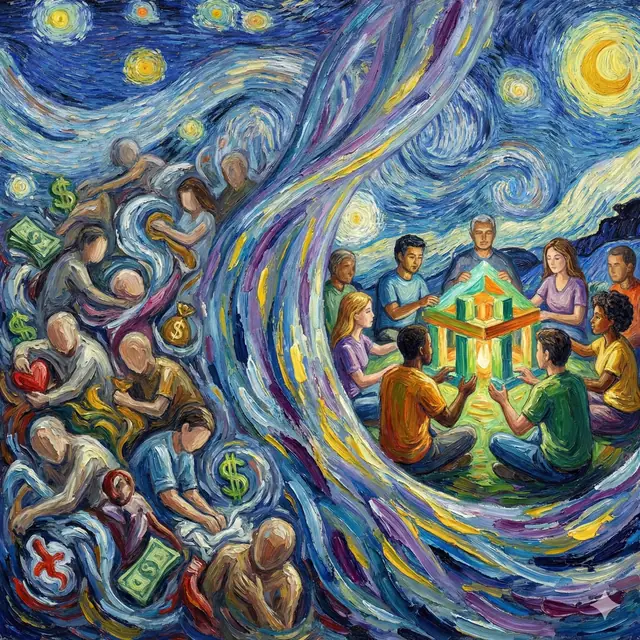
“Justice is the first virtue of social institutions, as truth is of systems of thought.” – John Rawls
When I think about what kind of society I want to live in, I often start with a thought experiment formulated by the American philosopher John Rawls. He called it the “veil of ignorance”.
The experiment asks us to imagine a situation where we are to design a society's rules, but without knowing who we ourselves will be in that society. I do not know whether I will be born rich or poor, healthy or sick, as a man or a woman, or whether I will grow up in a safe suburb or in a broken family without a safety net. Rawls argued that if we make decisions behind this veil, we will rationally choose a society that is as just as possible for everyone – because we ourselves could end up in the most vulnerable position (Rawls, 1971).
For me, this thought experiment leads to a clear conclusion: I want to live in a society that gives every human being, regardless of starting point, a genuine chance at a dignified life.
GAL-TAN: Beyond Left and Right
To understand where I stand politically, the traditional left–right scale is not enough. We also need to look at the GAL–TAN scale, a dimension that measures sociocultural values (Hooghe et al., 2002).
- GAL (Green, Alternative, Libertarian): Focuses on ecological sustainability, cultural tolerance and individual freedom in lifestyle matters.
- TAN (Traditional, Authoritarian, Nationalist): Emphasises traditional values, law and order, and national identity.
My compass points steadily towards the GAL side. I believe in an open society where environmental responsibility and human rights are non-negotiable cornerstones.
A Green Socialist Technocrat
I call myself a green socialist technocrat. It may sound like an eclectic label, but it rests on a logical triad:
- Socialist: Because I believe in a fair distribution of resources. It is not about erasing differences, but about securing a moral floor below which no one is allowed to fall through the net. It is about distributive justice – that a society's success is measured by how it treats its most vulnerable.
- Technocratic: The word comes from the Greek tekhne (skill) and kratos (power). As a technocrat I believe political decisions should be guided by facts, science and proven experience rather than by ideological dogma or short-term populism. Already in the 1800s, thinkers such as Henri de Saint-Simon proposed that society should be governed by experts and scientists in order to maximise the public's prosperity.
- Green: Because our planet is our only home. Without a functioning ecosystem, all other political discussions are irrelevant.
Reason as a Guide
I believe in a welfare system that embraces innovation, and in a state that sets clear rules of the game but allows individuals to grow. We face a time marked by climate crisis and rapid technological development, and we cannot afford to let emotional deadlocks steer the way forward. We need reason guided by empathy.
When someone asks where I stand, this is my honest answer. It may not be a label that fits on an election poster, but it is a position that requires both humility before facts and a willingness to understand other people's living conditions. Do we want to live in a society where only the strongest survive, or one where we create the conditions needed for as many people as possible to flourish?
The choice is ours, and we make it every day through the systems we choose to support. Engaging with this is part of my wellbeing, and the reason I have included it in this book.
Exercise
Behind the Veil
Purpose: To train your empathic ability and clarify your own social values through John Rawls's thought experiment (Rawls, 1971).
Step 1 – Put on the veil
Sit in stillness and close your eyes. Imagine that you are not yet born. You know nothing about your future body, your intelligence, your health or your family's finances.
Step 2 – Design the basic protections
From this uncertainty, write down the three most important things you would want society to guarantee you.
- Example: “Free access to healthcare regardless of income.”
- Example: “A school that compensates for parents' level of education.”
Step 3 – Value check
Look at your three points. Which of your personal values do they reflect? (E.g. security, justice, freedom).
Step 4 – Personal responsibility
How do you act in your everyday life to contribute to such a society? Can you make a conscious choice this week that lines up with your vision behind the veil? (E.g. supporting a local organisation, shopping sustainably or showing extra care for someone in a vulnerable position).
References (3)
- Hooghe, L., Marks, G., & Wilson, C. J. (2002). Does left/right structure party positions on European integration? Comparative Political Studies, 35(8), 965–989.
- Rawls, J. (1971). A theory of justice. Belknap Press of Harvard University Press.
- Saint-Simon, H. (1952). The doctrine of Saint-Simon: An exposition; First year, 1828–1829. Beacon Press. (Original work published 1829).
Want the book in your hands?
The whole of Välmåendecoach can be read here. The printed, signed edition is also available – and it can be read on the sofa without a screen.
Seeing your own blind spots usually takes one more person. This is how coaching works.