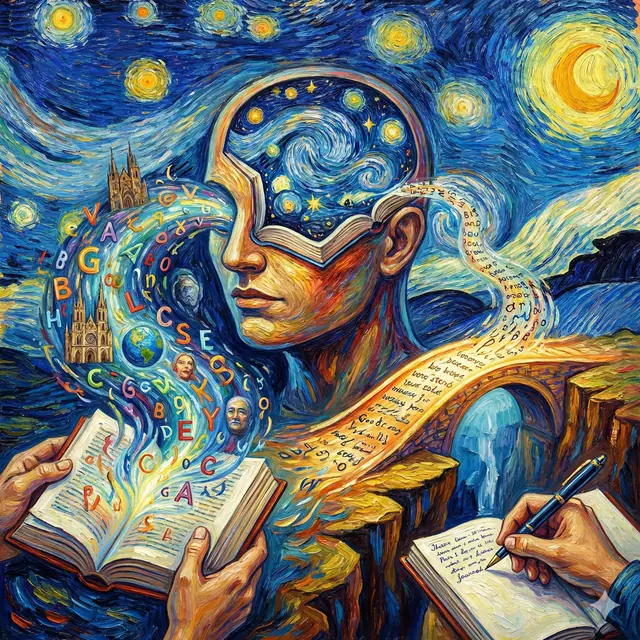
“Reading is to the mind what exercise is to the body.” – Joseph Addison
What really sets us apart from apes and dogs? One of the most decisive factors is our capacity for symbolic communication through writing. It is humanity's most remarkable innovation: a way of speaking to people who are not yet born, and of hearing the voices of those who died a thousand years ago. Dogs make do with a “woof”, but we have built cathedrals of words out of the alphabet, literature and modern digital conversations.
I myself read large amounts of literature and write every day. Many ask: “How do you find the time?” The answer is that I have stopped treating reading as a performance in which every word must be ticked off. I look for gold nuggets.
Strategic Reading: Panning for Gold
When I read non-fiction or cookbooks, I scan for what is relevant right now. I look for an idea to put into practice, or a tip to try in my everyday life. But when I open a novel or a biography, I change pace. There it is not about efficiency, but about letting myself be swept along.
The world's most successful people often share this obsession. Bill Gates is known for his “reading weeks”, in which he consumes enormous quantities of books by focusing on the big connections rather than the details. He sees reading as the fastest way to download someone else's lifetime of experience into his own brain.
The Neurobiology of Story
Reading is not merely an intellectual exercise; it physically changes our brain. The researcher Maryanne Wolf describes how reading creates new neural pathways that were not there before (Wolf, 2007).
Furthermore, research shows that fiction is one of our most effective tools for training empathy. When we read about a character's feelings, the same parts of our brain are activated as if we had experienced the event ourselves (Kidd & Castano, 2013). We literally build up our ability to understand other people by reading about them.
Writing as an Inner Compass
If reading is taking in the world, writing is organising our inner life. Putting our thoughts into words forces them to become clear. The psychologist James Pennebaker has, over decades of research, shown that “expressive writing” – writing down our deepest thoughts and feelings – can strengthen the immune system, lower blood pressure and help us process trauma (Pennebaker, 1997).
The author Julia Cameron has helped millions of people find their creativity through “Morning Pages” – three pages of unedited stream of consciousness every morning. The purpose is not to write beautifully, but to clear out the mental clutter (see Chapter 12) so that we can see clearly.
It does not need to be advanced. Read a paragraph. Write a sentence. Being able to put words to your inner life is the closest we come to magic in this world. Through words we build not only bridges to others, but also a stable foundation for ourselves.
Exercise
Three Minutes of Journaling
Purpose: To establish a daily routine for self-reflection which, according to research, strengthens emotional regulation and increases psychological wellbeing (Pennebaker, 1997).
Instructions: Set aside 3–5 minutes each evening. The most important thing is not what you write, but that you write honestly. Use these three points as your inner compass:
1. Gratitude (Positive reinforcement)
Write down one thing you are grateful for today.
- Why? This trains the brain to break its “negativity bias” and instead look for what actually works in your everyday life.
2. Reflection (Self-awareness)
Write down a specific thought or feeling you have had during the day.
- Example: “I felt stressed in the supermarket but chose to breathe deeply.”
- Why? Putting feelings into words reduces activity in the amygdala (the brain's alarm centre) and increases the sense of control.
3. Learning (Looking forward)
Write down one thing you have learned today, or one thing you want to try tomorrow.
- Example: “I learned that I need more quiet in the afternoons.”
- Why? This stimulates the brain's plasticity and makes your development an active process rather than a passive experience.
Tips for Success:
- Keep it simple: If you don't have the energy, just write one word per category.
- No censorship: No one but you will read this. Let the words flow freely.
- Pattern recognition: Read through your notes once a month. Which themes recur? What makes you happiest, and what drains you?
References (3)
- Kidd, D. C., & Castano, E. (2013). Reading literary fiction improves theory of mind. Science, 342(6156), 377–380.
- Pennebaker, J. W. (1997). Writing about emotional experiences as a therapeutic process. Psychological Science, 8(3), 162–166.
- Wolf, M. (2007). Proust and the squid: The story and science of the reading brain. HarperCollins.
Want the book in your hands?
The whole of Välmåendecoach can be read here. The printed, signed edition is also available – and it can be read on the sofa without a screen.
Want to give this space for real? A weekend for recovery.