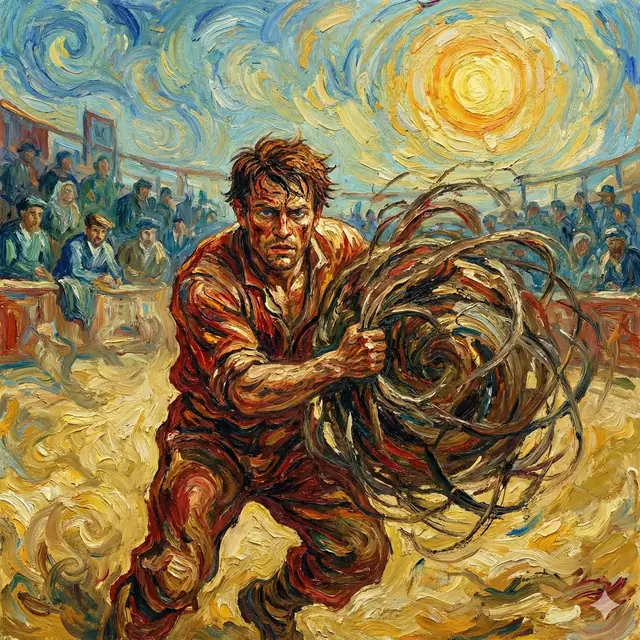
“It is not the critic who counts… The credit belongs to the person who is actually in the arena, whose face is marred by dust and sweat and blood.” – Theodore Roosevelt
Everything good in life begins with a challenge. It may sound like a cliché, but it is a truth that echoes through both history and modern psychology: we grow through resistance, never through comfort.
Think of your proudest moments. Almost all of them began with something that felt difficult, perhaps even frightening. Speaking before a group, completing a course you doubted you could finish, or getting through a painful break-up and finding new strength on the other side. It is in these moments of friction that our character is shaped and deepened.
Eustress: The Good Stress
In psychology we distinguish between distress (negative stress) and eustress (positive stress). The concept of eustress was introduced by the pioneer Hans Selye and describes the kind of tension that arises when we face challenges that are difficult but manageable.
Research shows that moderate stress, in the right dose, is actually necessary for our cognitive performance and health (Seery et al., 2010). This form of stress sharpens our focus, increases our energy and drives us to learn. According to the psychologist Kelly McGonigal (2015), it is less about how much stress we have and more about our attitude towards it. If we see stress as a resource that prepares us for action, rather than as a threat, it can actually lengthen our life and strengthen our resilience.
The Arena: Roosevelt and Malala
Theodore Roosevelt
put this best in his speech on “The Man in the Arena”. He argued that there is no honour in sitting in the stands and criticising. True development requires stepping down into the dust, daring to commit and accepting the risk of failing. It is the effort itself that gives life its value.
A more contemporary example is Malala Yousafzai. She faced a challenge that most of us can never even imagine. Instead of letting fear and opposition silence her, she used the challenge as a platform to change the world. Her journey shows that human beings have an extraordinary capacity for post-traumatic growth – not merely recovering from adversity, but developing into a stronger version of themselves because of it.
Choosing Friction
Development requires friction. If we always choose the easiest path, we risk stagnating. This does not mean you should go looking for disasters, but it does mean you need to stop seeing discomfort as a sign that something is wrong.
My own greatest breakthroughs have always been preceded by periods of confusion or inner struggle. It is in those moments that I have been forced to break old patterns and see the world with new eyes. Next time you face a challenge, do not ask yourself “Why is this happening to me?”, but rather “What does this demand of me, and who can I become on the other side?”.
Exercise
Your Personal Challenge Zone
Purpose: To identify and take on a manageable challenge in order to experience eustress and strengthen your psychological resilience (Seery et al., 2010).
Step 1 – Identify the resistance (5 min)
Write down three things you know would make you grow, but which you are currently avoiding because of discomfort.
- Example: Asking for a pay rise, starting that course, having a difficult conversation with a friend.
Step 2 – Choose your “just-right challenge” (5 min)
Choose one of these points. It should feel tingly and challenging, but not so overwhelming that you panic. We are looking for the “Peak Performance” zone on the Yerkes-Dodson curve.
Step 3 – Break down the stone (10 min)
Divide the challenge into 3–5 concrete sub-steps.
- Example (speaking before a group): 1. Write down the main points. 2. Practise out loud to yourself in front of the mirror. 3. Record yourself and listen back. 4. Give the presentation to a colleague. 5. Deliver it to the group.
Step 4 – Action and log (5 min/day)
Complete one step per day. Then write briefly in your diary:
- What did I do?
- How did the resistance feel before compared with after?
- What did I learn about my own ability?
Step 5 – Evaluation
After a week, reflect on your energy level. Do you feel increased pride or meaningfulness? Eustress tends to leave behind a sense of competence that no comfort in the world can buy.
References (4)
- McGonigal, K. (2015). The upside of stress: Why stress is good for you, and how to get good at it. Penguin.
- Roosevelt, T. (1910). Citizenship in a Republic. Speech delivered at the Sorbonne, Paris.
- Seery, M. D., Holman, E. A., & Silver, R. C. (2010). Whatever does not kill us: Cumulative lifetime adversity, vulnerability, and resilience. Journal of Personality and Social Psychology, 99(6), 1025–1041.
- Selye, H. (1974). Stress without distress. J.B. Lippincott.
Want the book in your hands?
The whole of Välmåendecoach can be read here. The printed, signed edition is also available – and it can be read on the sofa without a screen.
Challenges become opportunities faster with support. This is how coaching works.