“Do one thing every day that scares you.” – Eleanor Roosevelt
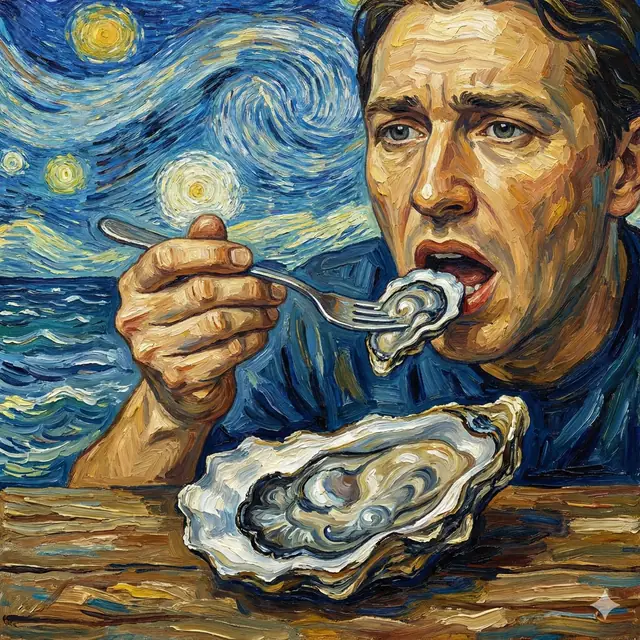
I should confess something: I have never eaten an oyster. There is something about the whole concept that grates on me. A glossy little lump of jelly that smells of the sea and looks like the result of a very stubborn cold. Calling it a delicacy sometimes makes me question the credibility of the entire gastronomic industry.
But here is the point: I have never tasted one. I actually don't know what it tastes like. All I have are preconceptions, fantasies and a few half-hearted reviews as support. I have condemned the experience before I have even given it a chance.
The Pioneer and the First Step
Someone must have been the first. The first person who picked up that hard, rough shell, prised it open and thought: “This looks disgusting – I have to taste it!”
It took courage. Perhaps it was curiosity, perhaps it was sheer desperation, but that step laid the foundation for an entire food culture. It is a reminder that almost everything we today regard as valuable, beautiful or self-evident once required someone to dare to step out into the unknown.
It is exactly this kind of courage I want to talk about. Not necessarily the courage to jump out of an aeroplane or climb a mountain, but the small, everyday acts of courage that may seem insignificant to an outsider, but can change everything for the individual.
The Courage to Fail: Roosevelt and Rowling
Eleanor Roosevelt
, one of history's most influential diplomats, was as a young woman extremely shy and afraid of social situations. She made it her life philosophy to consistently expose herself to what she feared. She understood that courage is not an innate trait, but a muscle that is trained by doing the things we do not believe we can manage.
The author J.K. Rowling has spoken movingly about the courage to fail. Before the success of Harry Potter she lived in straitened circumstances and was met with dozens of rejections. She argues that it took more courage to keep writing a manuscript that nobody seemed to want than it ever took to handle later success. For her, “tasting the oyster” meant carrying on despite the fear of being rejected (Rowling, 2008).
What Is Your Oyster?
Courage looks different for everyone. For one person it is quitting a secure job to follow a dream. For another it is asking for help, saying “I love you” for the first time, or daring to give a talk with trembling knees.
It is about challenging your own limits. According to the psychologist Albert Bandura, we build our “self-efficacy” by accumulating victories over our own fears. Every time you do something that feels uncomfortable but important, you send a receipt to your brain: “I managed that too” (Bandura, 1997).
The question, then, is not whether you like oysters. The question is: What is your oyster right now? And will you dare to taste it?
(Don't forget to chew. It usually helps.)
Exercise
The Ladder of Courage
Purpose: To reduce the power of fear and strengthen your self-efficacy through gradual exposure (Norton & Weiss, 2009).
Step 1 – Identify your “oyster”
Start by identifying something you find unpleasant or frightening, but which is not totally paralysing. It should be something that limits you in everyday life.
- Scale: Give the situation a courage score from 1 to 10 (where 10 is maximum discomfort). We are looking for something around a 4 or 5.
Step 2 – Build the ladder (exposure in small steps)
If your challenge feels too big, break it down into smaller sub-steps. This is the core of cognitive behavioural therapy (Barlow et al., 2011).
- Example (speaking before a group):
- Write down what you want to say.
- Say it out loud to yourself in the mirror.
- Say it to a close friend.
- Say one sentence at a meeting with five people.
Step 3 – Mental simulation
Sit down and imagine carrying out the challenge. Visualise not only the outcome, but also the feeling of going through the discomfort and coming out the other side. Research shows that this type of visualisation strengthens both motivation and the ability to carry things out (Taylor & Pham, 1996).
Step 4 – Act and reflect
Take the step. Afterwards, write down your answers to the following questions:
- What was the worst that happened? (Often the imagination is worse than reality.)
- How did it feel in the body when it was over?
- What did you learn about your ability to handle discomfort? (Schön, 1983).
Step 5 – Next step
When the first step on the ladder feels manageable, it is time to climb on. Courage does not grow through magic, but through accumulated experience.
References (6)
- Bandura, A. (1997). Self-efficacy: The exercise of control. W.H. Freeman.
- Barlow, D. H., Allen, L. B., & Choate, M. L. (2011). Toward a unified treatment for emotional disorders. Behavior Therapy, 42(3), 271–288.
- Norton, P. J., & Weiss, B. J. (2009). The role of courage on behavioral approach in a fear-eliciting situation. The Journal of Anxiety Disorders, 23(2), 212–217.
- Rowling, J. K. (2008). The fringe benefits of failure, and the importance of imagination. Commencement speech delivered at Harvard University.
- Schön, D. A. (1983). The reflective practitioner: How professionals think in action. Basic Books.
- Taylor, S. E., & Pham, L. B. (1996). Why thinking about goals and performance improves performance. Psychological Review, 103(2), 193–209.
Want the book in your hands?
The whole of Välmåendecoach can be read here. The printed, signed edition is also available – and it can be read on the sofa without a screen.
Daring to do the uncomfortable can be practised systematically. This is how coaching works.