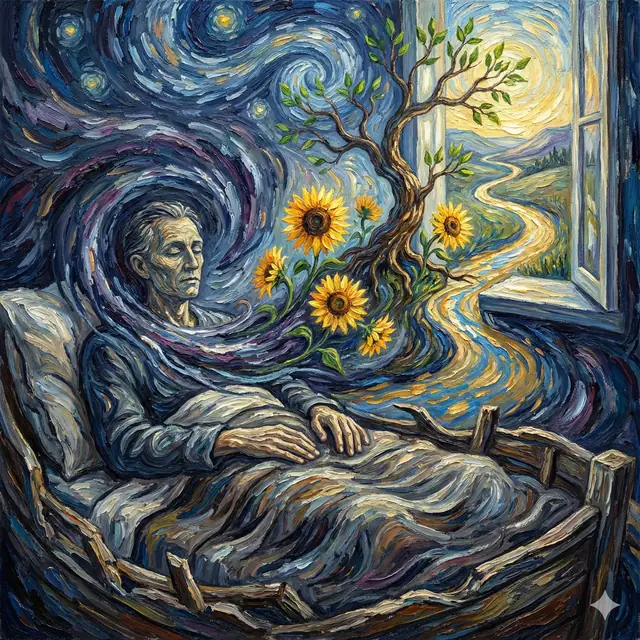
“I have no choice but to accept it. But acceptance is not the same as giving up. It means understanding what is, so that you can work out how to move on.” – Michael J. Fox
Illness carries a paradoxical fragility. It is rarely the pain or the fever itself that is hardest to handle, but the experience of no longer being able to be the version of yourself the world expects. When your energy runs out, so does the ability to be the present parent, the productive colleague or the driven individual. The world keeps spinning at its usual pace, while your own life is forced into an involuntary pause.
Childhood Rest versus Adult Resistance
When we were children, illness was often associated with a kind of legitimate rest: an excuse to be looked after and spared demands. As adults we tend to see illness as an obstacle, a limitation that steals time from everything we ‘should’ be getting done. We resist the body's signals because our identity is so tightly bound up with our health and our performance.
But illness is a natural part of biological existence. We are born with different conditions and genes, and we will all face periods when the body sets the limits. Relating to those limits with respect rather than contempt is one of our most important challenges.
Sickness Behavior: When the Body Speaks to the Mind
An important insight is how similar the symptoms of physical illness and mental ill-health actually are. In immunopsychology, researchers speak of ‘Sickness Behavior’ (Dantzer et al., 2008). When the immune system is activated, pro-inflammatory proteins known as cytokines are sent to the brain. These make us withdraw socially, become sluggish in our thinking and feel a lowered mood.
This is a biological survival mechanism designed to save energy so that the body can heal. But for the uninitiated, it is easy to misread this sluggishness as anxiety or early burnout. Sometimes the psychological fragility is simply a by-product of a physical infection. Understanding this link can reduce the shame we feel when we ‘can't manage to be ourselves’.
Michael J. Fox and Frida Kahlo: Living with Limitation
Some illnesses pass, while others become permanent companions. The actor Michael J. Fox, through his Parkinson's disease, has become a symbol of radical acceptance. He stresses that he cannot control the progression of the disease, but he can control how he relates to it. By accepting his new reality, he has been able to go on contributing to the world in a new and deeper way.
The artist Frida Kahlo lived for most of her life in chronic pain after an accident in her youth. Rather than letting the illness define her as a victim, she used her vulnerability as raw material for her art. She showed that one can be both fragile and powerful at the same time. For her, the bed became not only a place of suffering, but a place of creation (Kahlo, 1995).
Acceptance as Healing
Being ill is therefore about more than simply becoming physically well again. It is about practising acceptance – seeing your own vulnerability without judging it. Resting when the body demands it is not a sign of weakness, but of high self-awareness. By making peace with the body's limitations, we can return to life with a deeper respect for the resources we actually have.
Exercise
The Body's Compass – A Reflective Acceptance Exercise
Purpose: To develop psychological resilience and reduce mental resistance during physical or emotional exhaustion (Neff & Germer, 2013).
Step 1 – Body Scan (3 min)
Lie down or sit comfortably. Close your eyes and move your attention from your toes up to your head. Notice where there is tension, feverish heat, tiredness or discomfort. Try simply to observe these sensations, without wanting to change them or attaching labels such as ‘bad’.
Step 2 – Writing Reflection (5 min)
Answer these three questions to gain clarity:
- What is my body signalling right now? (E.g. ‘My eyes feel heavy, my head is throbbing’.)
- What is my most basic need? (E.g. darkness, quiet, fluids, a warm blanket.)
- What can I allow myself to pause today? Write down one thing you can genuinely let go of without the world falling apart.
Step 3 – Cognitive Reframing (2 min)
Instead of thinking ‘I should be able to cope with more’, try using a more self-compassionate mantra. Say to yourself:
- “My body is fighting for my health right now. I support it by giving it space to rest.”
Step 4 – Trust
Rest in the knowledge that your body has an enormous innate capacity for healing. By ceasing to fight the symptoms, you free up energy that can go towards recovery instead.
References (5)
- Creswell, J. D., et al. (2016). Alterations in resting-state functional connectivity link mindfulness meditation with reduced interleukin-6: A randomized controlled trial. Biological Psychiatry, 80(1), 53–61.
- Dantzer, R., O'Connor, J. C., Freund, G. G., Johnson, R. W., & Kelley, K. W. (2008). From inflammation to sickness and depression: When the immune system subjugates the brain. Nature Reviews Neuroscience, 9(1), 46–56.
- Kabat-Zinn, J. (1990). Full catastrophe living: Using the wisdom of your body and mind to face stress, pain, and illness. Delta.
- Kahlo, F. (1995). The diary of Frida Kahlo: An intimate self-portrait. Abrams.
- Neff, K. D., & Germer, C. K. (2013). A pilot study and randomized controlled trial of the mindful self-compassion program. Journal of Clinical Psychology, 69(1), 28–44.
Want the book in your hands?
The whole of Välmåendecoach is available to read here. A printed, signed edition is also available – and it can be read on the sofa without a screen.
Vulnerability is easier to carry in company. How coaching works.