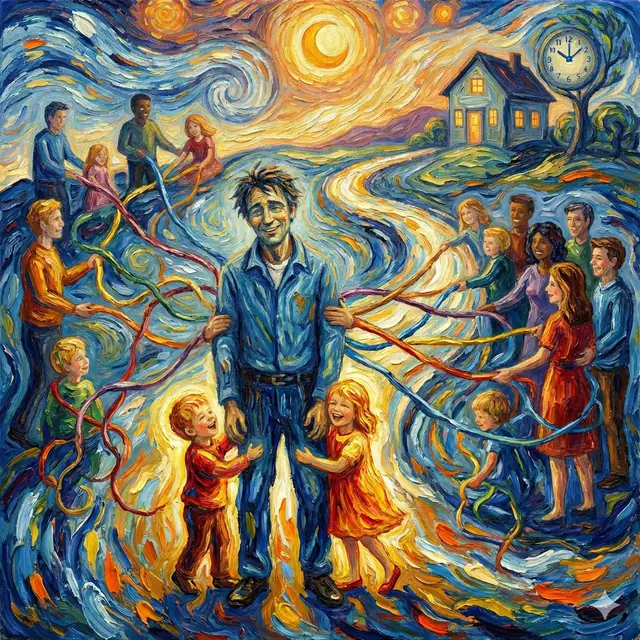
“You get back what you put in. If you want love, give love. If you want friends, be friendly. If you want to be understood, be understanding.”
I'll be honest: I have never been particularly good at relationships. It is not that I don't care – on the contrary, I often carry a great deal of concern for the people in my life. The problem is that I often lack the executive energy and focus needed to keep them going. I forget to get in touch, I lose track of birthdays and I miss subtle social signals. My brain is simply busy somewhere else.
But there are two exceptions. Two small people, aged 7 and 9, who have the leading roles in my life. They are my anchor. They remind me every day that relationships do not look after themselves. They demand an active presence that challenges my ADD brain, but they also give it its deepest meaning.
The Relationship as Work: Gottman's Bids
In relationship psychology, John Gottman speaks of ‘bids for connection’. These are the small ways in which we seek each other's attention – a glance, a question or a comment about something we notice. Gottman's research shows that the couples and friends who stay together are the ones who ‘turn toward’ each other's bids rather than ignoring them (Gottman, 2011).
For someone with ADD, the challenge is even noticing these bids amid the inner noise. Learning to see these small signals is not just a social skill; it is an act of love.
Chosen Ties and Imposed Bonds
We can divide our relationships into two categories: the chosen and the imposed.
- The chosen relationships (friends, partners) are the ones we have picked ourselves. Paradoxically, these are often the ones that suffer when our energy runs low, because we take for granted that they ‘understand’.
- The imposed relationships (relatives, colleagues) call for a different strategy: a balancing act between acceptance and clear boundaries.
Even a genius like Albert Einstein wrestled with this. He was deeply committed to humanity as a whole, but found individual, personal relationships extremely complicated and draining. He often preferred solitude to protect his intellectual energy, yet he also recognised that human beings are social animals who need belonging in order not to wither.
Relationships as Mirror and Lens
Our relationships work both as a mirror – where we see ourselves through other people's eyes – and as a lens through which we see the world. The long-running Harvard study (Waldinger & Schulz, 2023) has shown that the quality of our relationships is the single most important factor for a long and happy life. They protect our brain and our body more than wealth and fame do.
I am writing this chapter as much for myself as for you. I need to remind myself that it is never too late to become a better fellow human being. Looking after the people you want to keep in your life is not an achievement – it is a lifelong practice of presence and forgiveness.
Exercise
Relationship Inventory and Reaching Out
Purpose: To increase awareness of your social network and break passivity through small, manageable steps (Waldinger & Schulz, 2023).
Step 1 – The Relationship Map (10 min)
Draw a circle with yourself in the middle. Place your relationships in three levels:
- Innermost circle: Your closest (chosen) relationships. The ones that give you energy and security.
- Middle circle: Important but more functional or imposed relationships (colleagues, certain relatives).
- Outermost circle: Acquaintances, old friends or occasional contacts.
Step 2 – Self-Reflection (15 min)
Answer the following questions in writing:
- Which relationship in your innermost circle have you neglected lately? What is it due to?
- Is there someone in the middle circle who takes too much energy? How can you set a clearer boundary?
- Who in the outermost circle do you miss? Would you like to move that person one step in?
Step 3 – Reaching Out (Micro-Action)
Choose one person from your map whose connection you want to strengthen. Send a short message straight away, without overanalysing.
- Suggestion: “I was sitting thinking about you today and it reminded me of [shared memory]. Hope you're doing well!”
- Suggestion: “Thank you for being in my life. I appreciate our connection, even though I'm bad at getting in touch.”
Step 4 – Follow-Up
Note how it feels after you have reached out. Often the fear of being ‘a nuisance’ or ‘too late’ is far bigger in our own heads than in the recipient's. Responding to a bid, or making one of your own, is the only way to keep the garden of a relationship alive.
References (4)
- Gottman, J. M. (2011). The science of trust: Emotional attunement for couples. W. W. Norton & Company.
- Holt-Lunstad, J., Smith, T. B., & Layton, J. B. (2010). Social relationships and mortality risk: A meta-analytic review. PLoS Medicine, 7(7), e1000316.
- Johnson, S. (2019). Hold me tight: Seven conversations for a lifetime of love. Little, Brown Spark.
- Waldinger, R. J., & Schulz, M. S. (2023). The good life: Lessons from the world's longest scientific study of happiness. Simon & Schuster.
Want the book in your hands?
The whole of Välmåendecoach is available to read here. A printed, signed edition is also available – and it can be read on the sofa without a screen.
Relationships are rarely easy to see clearly from the inside. How coaching works.