“It is not what happens to you, but how you react to it that matters.” – Epictetus
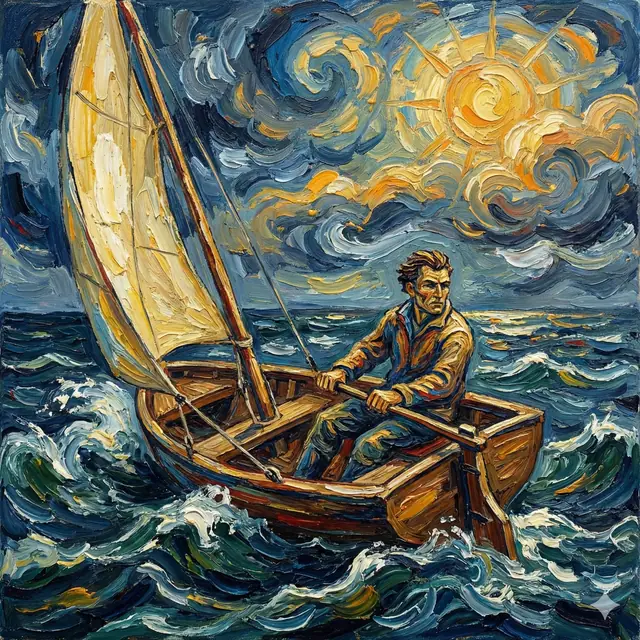
Imagine you are sitting in a small sailing boat in the middle of an endless ocean. All around you there is only the horizon and the sound of waves striking the hull. You are faced with a choice: you can hoist the sails and actively steer towards a destination, however distant it may be. Or you can let the sails hang slack and drift passively with the currents.
Neither option is morally right or wrong – but the likelihood that you will reach a place you actually want to go is far greater if you take the helm.
This is a metaphor for our relationship with control. We have to accept the brutal truth that we can never steer the ocean. We cannot change the wind, the waves or the tides. In the same way, we cannot control other people's thoughts, decisions or the world economy. But we have absolute power over how we trim the sails, how we hold the helm and how we navigate through the storm.
Epictetus and the Slave Who Was Free
Ancient philosophy, Stoicism, is built entirely on this distinction. Epictetus, one of the best-known Stoics, was born a slave. He did not even own his own body. Despite this, he taught that freedom means understanding what is ‘up to us’ and what is not. If we try to control what lies outside our power (such as what our master, or today our boss, thinks of us), we become slaves in our minds. But if we focus on what we can govern (our character, our reactions), we remain free, whatever the external circumstances.
The need for control is often misdirected energy. It arises when we try to steer the waves instead of the boat. This leads to frustration and exhaustion. But to abdicate altogether – to let go of the helm and say “it doesn't matter” – is not the way forward either. It leads to us becoming victims of circumstance.
Captain Sully and the 208 Seconds
A modern example of this distinction is Captain Chesley ‘Sully’ Sullenberger. When a flock of geese flew into the engines of his Airbus A320 over New York, he lost all engine power. He had zero control over the birds. He had zero control over gravity. Had he spent his 208 seconds cursing bad luck or the birds, everyone on board would have died.
Instead, he focused radically on the only things he could control: the aircraft's glide angle and his own presence of mind. He landed the plane on the Hudson River and saved 155 lives. That is the difference between trying to control the outside world and having control over yourself.
Being in Control versus Being Controlled
Being in control is not about being a dictator over your existence, but about having the discipline to take responsibility for your actions. Being controlled, on the other hand, means being steered by other people's whims, your own fears or chance.
Sometimes it can be wise to drift with the currents for a while in order to recover. But sooner or later the sails must be hoisted. And then it matters that you know where you are going – and that you are ready to steer there, however the wind blows.
Exercise
The Circle of Control
Purpose: To reduce stress and increase capacity for action by visually sorting the factors in a challenging situation (Covey, 1989; Seligman, 2011).
Background: Research in cognitive behavioural therapy (CBT) shows that perceived self-efficacy (confidence in your own abilities) increases when we focus on the factors we can influence.
Step 1 – Name the Storm
Choose a situation that is currently causing you stress or worry. Write it down.
- Example: “The reorganisation at work.”
Step 2 – Draw the Circles
Draw three circles inside one another (like a target):
- Innermost circle: My Control.
- Middle circle: My Influence.
- Outermost circle: Beyond My Control (The Circle of Worry).
Step 3 – Sort Your Factors
Place the parts of your situation in the right circle.
- My Control: (What can I do today?)
- Example: Update my CV, my attitude in meetings, my work routines.
- My Influence: (What can I influence but not control?)
- Example: The atmosphere in the team, the manager's view, the project timeline.
- Beyond My Control: (What must I accept?)
- Example: Management's final decision, the economy, colleagues' rumours.
Step 4 – Shift the Energy
Look at your outermost circle. Cross out these points or imagine throwing them overboard. They are ballast. Now look at the innermost circle. Choose one concrete action you can take within 24 hours.
Step 5 – Act and Let Go
Take the action. For everything that lies beyond your control, practise the acceptance mantra:
“I cannot control the wind, but I can adjust my sails.”
References (3)
- Covey, S. R. (1989). The 7 habits of highly effective people: Powerful lessons in personal change. Free Press.
- Hofmann, S. G., Asnaani, A., Vonk, I. J., Sawyer, A. T., & Fang, A. (2012). The efficacy of cognitive behavioral therapy: A review of meta-analyses. Cognitive Therapy and Research, 36(5), 427–440.
- Seligman, M. E. P. (2011). Flourish: A visionary new understanding of happiness and well-being. Free Press.
Want the book in your hands?
The whole of Välmåendecoach is available to read here. A printed, signed edition is also available – and it can be read on the sofa without a screen.
Separating what you control from what you don't is a craft. How coaching works.