The shadow gives us shelter
The light burns in the gaze
Dare to see your world.
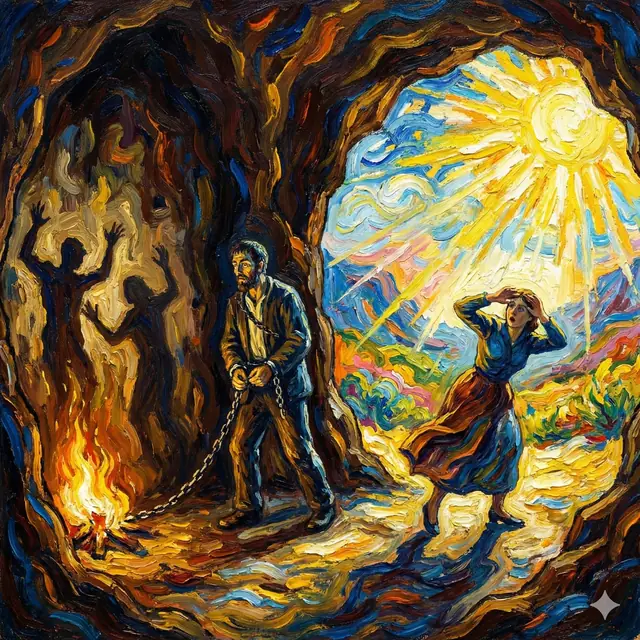
Picture a cave. Far inside sits a prisoner, chained in place. He has sat there his whole life, his gaze fixed on the bare stone wall in front of him. Behind him a fire burns, and between the fire and his back, people and objects pass by.
The fire casts shadows on the wall in front of the prisoner. For him these shadows are not just dark patches – they are his entire world. They are his truth. His reality.
One day the chains come loose. The prisoner turns round, dazzled by the fire, and stumbles out of the cave, into the sunlight. The world outside is vivid, three-dimensional and overwhelming. Reality strikes him with full force.
But what does he do? He becomes afraid. The light stings his eyes. Freedom is frightening. So he turns back. He walks back into the darkness, puts the chains on again and stares at the shadows. For in there he feels safe. In there he knows how the world works.
The Illusion of Safety
This story is over 2,400 years old, taken from the philosopher Plato's most famous work, The Republic (Plato, c. 375 BCE/2017). But it is just as relevant today. You have seen the same theme in the film The Matrix, where Neo is faced with a choice between the red pill (the truth) and the blue pill (the illusion).
Many of us may be physically free today, but many of us still sit in the cave. We choose the familiar, the safe, the predetermined. We call it reality, but it is often an illusion we have learned to love so that we do not have to face the unknown.
The psychologist Carl Jung spoke of “the shadow” – the sides of ourselves that we do not want to acknowledge and therefore push down into the unconscious (Jung, 1964). Until we dare to meet them, they will steer our lives without our understanding why.
Whatever the reason you have this book in your hand, it is a sign that you may have started to glance towards the mouth of the cave. That is why I want to ask you three simple but decisive questions:
- Why are you here?
- What do you want?
- How will you get there?
Do not answer them lightly. Your answer may be the map you need to find your way out into freedom, towards a brighter future.
My Journey Out of the Darkness
I will try to give my own answers, or at least describe how I have navigated over the years. I have been stuck. I have been set free. And I am still struggling to develop myself, even when reality feels frightening and challenging.
There comes a point in life when reality can no longer be fled from. Then you realise that what you believed was safety may just have been habit and fear. And that life can, in fact, be something more.
I am now in the middle of life. My children are growing and becoming individuals in their own right. My body is getting stiffer and recovery takes longer. My brain is not as quick at processing, but it is better at seeing patterns. Suddenly it is no longer obvious who I am or where I am going.
But something inside me still wants to keep understanding.
This is my journey. My way out of the cave. My struggle with the shadows and my dance with the light. But perhaps, if you dare to read on, it can also become the beginning of your own journey.
Here We Go!
References (2)
- Jung, C. G. (1964). Man and his symbols. Dell.
- Plato. (2017). Staten [The Republic] (J. Svensson, trans.). Bokförlaget Nya Doxa. (Original work published c. 375 BCE).
Want the book in your hands?
The whole of Välmåendecoach is available to read here. A printed, signed edition is also available – and it can be read on the sofa without a screen.