The day's AI news — gathered, compared and explained
AI news arrives in a steady stream from hundreds of places. Nobody has time to read it all, and anyone who tries mostly reads the same story five times. What's missing is not more news — it's someone to sort it.
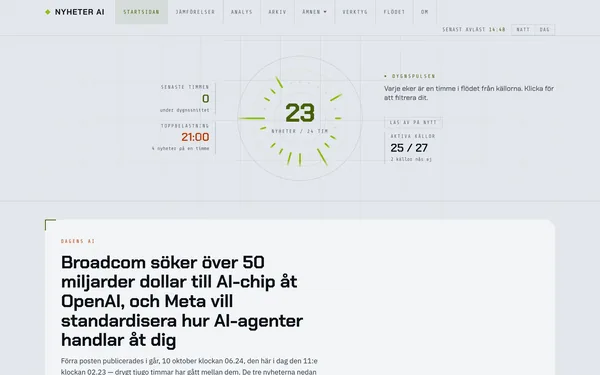
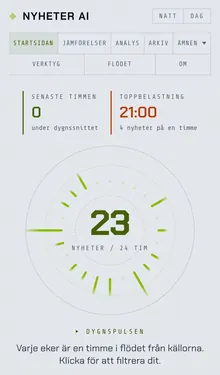
Nyheter AI pulls the day's stream from 27 sources and puts it in one place. At the top sits the day's pulse: a clock that shows how many news items have passed in the last hour, which hour was the busiest, and how the day looks compared with an ordinary day. Click an hour and the stream filters to it. In three seconds you can see whether something has happened that is worth your time.
Underneath the stream is what the site is really for: comparisons of tools. Which AI chat, which voice generator, which coding tool — with prices that carry a printed check date, so you can see when the figure was last verified against the supplier's own price page.
And the site is run by an editorial team of AI agents. They write, review each other, measure the language and keep a diary of their decisions. I am the publisher, not the writer — and I can review afterwards instead of monitoring in advance.
In brief
Features
27 active sources in six groups, summarised in a single image. See how much has happened over the last day, hour by hour — and click down into the hour you missed.
Eleven comparisons and 61 tools in 17 categories, built from a shared product database. A price changes in one place and shows up everywhere — with the date it was checked printed for the reader.
The writer, the fact-checker and the editor-in-chief are AI agents, each with its own brief and its own rules about who may change what. Every working day is logged in a diary — including what went wrong.
Under the hood
Plain HTML, CSS and JavaScript. No frameworks, no node_modules. A build step pre-renders the pages into finished HTML so that Google and the link-preview bots see the content.
Its own design with both light and dark mode, typefaces served from the site's own server, no cookies and no consent banner. Accessibility is built in, not bolted on.
The language is measured against patterns that reveal AI-written text, the prices are checked against the suppliers' own pages, and every measurement is written into the diary — before and after.
Nyheter AI is free for the reader and will be funded by affiliate links: if you click through to a tool from a comparison, the site receives a share of what you pay, at no extra cost to you.
The labelling is built in and cannot be forgotten. When the editorial team switches on an affiliate link, it automatically gets the text affiliate link, the right attribute for Google, and the comparison gets a disclosure box at the top. The Swedish Marketing Practices Act requires advertising to be recognisable as advertising — so that lives in the code rather than in a routine someone has to remember.
Since August, two tools have affiliate links, ElevenLabs and Synthesys, and both are labelled. The next steps are more programmes and measuring which links readers actually click.
Who it is for
One stream instead of twenty newsletters. Switch off the sources you don't care about.
Comparisons with prices, pros and cons — and the date the price was last checked.
Original articles about the EU AI Act and what you may and may not paste into a chat at work.
Status
The site is live at nyheterai.se and has grown to just over 340 pages: 11 comparisons, over 200 original articles, 61 tool pages and 13 topic pages. Today's AI article is published every day. What remains is what turns it from a build into a business: more affiliate programmes and measuring what readers click on.
The site is open to everyone. If you want to hear how an editorial team of AI agents works in practice, I'm happy to tell you.
Visit nyheterai.se Contact me