Short answer
The veil of ignorance is a thought experiment about justice. You are to choose the rules for a society without knowing who you yourself will be in it – rich or poor, healthy or ill, religious or not.
The philosopher John Rawls described it in A Theory of Justice in 1971. He argued that people behind the veil would choose two principles: equal basic liberties for all, and that inequalities are just only if opportunities are fairly distributed and the differences benefit those who are worst off.
The conclusion has been questioned ever since, but the question itself – would I accept this rule if I didn't know where I would end up? – can be used far outside politics.
What the thought experiment is
John Rawls (1921–2002) was a professor of philosophy at Harvard. He wanted to find a method for deciding what is just in the basic structure of a society – the institutions that distribute rights, opportunities and resources – without the answer simply reflecting who was asking.
His solution was an imagined negotiation he called the original position. A number of parties are to choose together the principles by which society will be governed. They are rational and want things to go as well as possible for themselves. But they choose behind a veil of ignorance: they don't know which place they themselves will have once the principles take effect.
The point is that the veil turns self-interest into impartiality. Someone who doesn't know whether they will be the employer or the employee cannot rig the rules in their own favour. What remains is to choose rules you can live with wherever you end up. Rawls called his theory justice as fairness, because the principles are just precisely because they are chosen under fair conditions.
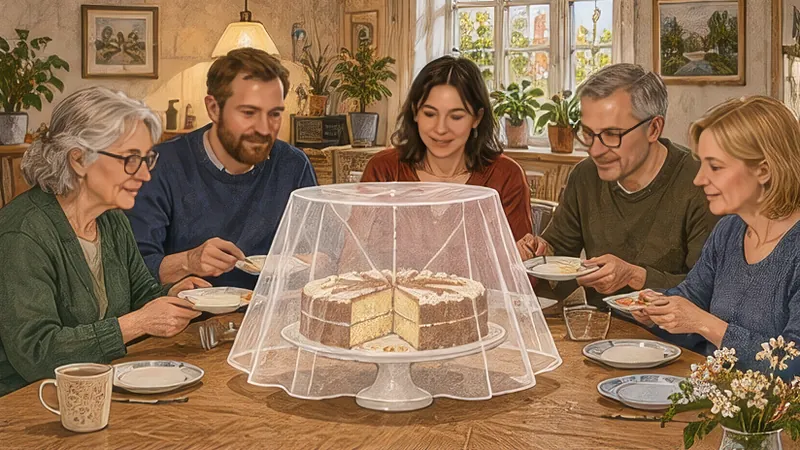
It is important to see that the original position is not a historical event. Nobody has ever sat behind the veil. It is a tool for thinking, rather like two children sharing a cake by having one cut and the other choose first: nobody needs to be good for the result to be even.
What you don't know behind the veil
Rawls made the veil thick. The parties do not know
- their place in society: class, income and social status
- their natural endowments: intelligence, strength and health
- their idea of what a good life is, and their religious or philosophical convictions
- their psychological traits, such as how much risk they can tolerate
- which society and which generation they belong to
They do, however, know general things: how societies and economies work, what psychology says about people, that resources are limited and that people hold different views about life. They also know that everyone, whatever they want from their lives, needs certain basic goods – liberties, opportunities, income and the social bases of self-respect.
That the parties don't even know what they themselves believe in is the part that sets Rawls apart from an ordinary call to put yourself in someone else's shoes. It is not enough to think “what if I were poor”. You are not to know whether you will be religious or an atheist, cautious or bold, either.
Rawls's two principles of justice
Rawls argued that the parties behind the veil would arrive at two principles. He adjusted the wording over the years; in his restatement from 2001 they read, in short:
- The principle of equal liberty. Each person has the same claim to a fully adequate scheme of equal basic liberties – freedom of speech, liberty of conscience, the right to vote, the integrity of the person – compatible with the same scheme for all.
- The principle for inequalities. Social and economic inequalities are acceptable only on two conditions:
- they are attached to positions open to all under fair equality of opportunity, and
- they are to the greatest benefit of the least advantaged members of society – the difference principle.
The principles are ranked. The liberties in the first may not be traded away to gain economic advantages, and fair equality of opportunity comes before the difference principle. That means you may not buy higher growth with restricted freedom of speech, nor by shutting certain groups out of education or occupations.
The difference principle is the most debated. It does not require everyone to have the same. A doctor may earn more than an assistant nurse, if the arrangement that makes that possible also makes things better for those who are worst off – for example because it draws more people into training. What is not permitted is inequality that only benefits those who are already well off.
Why choose that way? Maximin
Why would anyone behind the veil choose the difference principle in particular and not, say, the society that produces the most prosperity in total? Rawls's answer rests on a decision rule called maximin: choose the alternative whose worst outcome is better than the worst outcomes of the other alternatives.
Maximin is not a wise rule in every situation. Someone who always chose by the worst conceivable outcome would never change jobs or buy a flat. Rawls therefore argued that it fits under three particular conditions: when there is no secure basis for estimating the probabilities, when what you are guaranteed is something you can live a good life with, so that gains above it matter less, and when the other alternatives can lead to outcomes you cannot accept.
Behind the veil, he argued, all three hold. The stake is your whole life and your children's lives. You cannot choose again if you land badly. It is then reasonable first of all to make sure that even the worst position is one you can live in.
The criticism: Harsanyi, Nozick and Sandel
A Theory of Justice became one of the most discussed books of political philosophy of the last century, and criticism came from several directions. Three objections are worth knowing.
Harsanyi: choose the average
The economist John Harsanyi, who later received the Nobel memorial prize in economics in 1994, had already used a similar idea in the 1950s: an impartial person who doesn't know who they will be. But he reached a different answer. If you have an equal chance of becoming anyone, it is rational to choose the society in which average welfare is highest – a form of utilitarianism.
In a critique from 1975 Harsanyi argued that maximin is irrational because the rule lets even a very small risk of the worst outcome decide everything. Someone who followed maximin in everyday life would never take a flight. The debate shows something important: the same veil can lead to different conclusions depending on what you think is a rational way to handle uncertainty.
Nozick: it is how you got there that counts
Robert Nozick, Rawls's colleague at Harvard, replied in 1974 with Anarchy, State, and Utopia. He argued that justice is not about what the distribution looks like at a given moment, but about how it came about. If property has been acquired and transferred in a just way, the result is just, however uneven it becomes.
His famous example concerns the basketball player Wilt Chamberlain. Suppose the distribution in a society is exactly as you want it. Then a million people freely choose to pay Chamberlain 25 cents each to watch him play. Now he is very rich, and the distribution has changed. What was unjust about that? Nozick's point was that any pattern of distribution has to be maintained by constantly interfering in people's free choices.
Sandel and the communitarians: who is doing the choosing?
The third criticism was aimed at the person behind the veil. The philosopher Michael Sandel argued in 1982 in Liberalism and the Limits of Justice that Rawls starts from a self that can be stripped of everything that makes us who we are – family, community, faith, history. Yet we often discover what is right precisely through the contexts we belong to, not in spite of them. Similar objections came from Alasdair MacIntyre and Michael Walzer, among others.
A related criticism came from Susan Moller Okin, who in 1989 in Justice, Gender, and the Family pointed out that Rawls took it for granted that the family was just instead of testing it. If the family is where we first learn what justice is, she argued, then the division of work and power at home must also be open to testing behind the veil.
Rawls took some of the criticism on board. In Political Liberalism in 1993 he described his theory as a political conception that people with different worldviews should be able to agree on, not as a comprehensive doctrine of the good life.
What happens when people try it?
The thought experiment has also been tested in experiments. During the 1980s the political scientists Norman Frohlich and Joe Oppenheimer had groups discuss their way to a principle of distribution without knowing what income they themselves would receive (the first results appeared in 1987 and are summarised in the book Choosing Justice, 1992). The difference principle was rarely chosen. Most groups instead chose to maximise average income with a floor – a guaranteed minimum that nobody could fall below. That lies somewhere between Rawls and Harsanyi.
In 2019 the researchers Karen Huang, Joshua Greene and Max Bazerman published seven experiments with just over 6,000 participants in the journal PNAS. Participants who were first asked to reason behind a veil – for example to imagine that they could equally well be any of the people involved in a moral dilemma – more often chose the option that saved the most people. The effect also held for real decisions about which charity to give money to.
That doesn't tell us who is right in the philosophy. But it shows that the veil is not just an idea in a book. Deliberately thinking away your own position actually changes how people judge a situation.
The veil in everyday life
Rawls wrote about the basic structure of society, not about who should do the washing-up. But the question he asked can be used in smaller settings too, as long as you remember that it is an aid to thinking and not a formula that gives you the answer.
At work. Rotas, holiday periods, who gets the boring tasks, what pay criteria look like. The person drawing up the rota who already knows they have no children or don't work weekends sees the matter from one position. Ask instead: if I didn't know which of us I was, how would I want it shared out?
In the family. Siblings sharing, housework, rules on screen time that should also apply to the adults. “I cut, you choose” is the veil of ignorance in miniature. Okin's objection is a good reminder: the family is also a place where justice is distributed, and the person with the most power there is seldom the one who sees it most clearly.
In a club or association. Statutes, fees, who gets the best training times, how new members are admitted. Rules written before you know whom they will affect are more often rules that hold when conflict comes.
One way to do it in practice:
- State the rule, not the case. Not “should Anna get Christmas off?” but “how do we share out time off at Christmas?”.
- List the positions. Which different situations can people be in when the rule applies? The new hire, the one with small children, the one who is ill, the one who always says yes.
- Try the worst position. If you knew you would end up there – could you live with the rule, and would you think it could be defended?
- Count the cost. What does the protection cost the others? A rule that protects the worst position but makes everyone's everyday life much worse is also worth testing.
- Ask the people affected. You cannot forget who you are. Someone who actually stands in another position sees things you don't.
The last step matters. The veil is a thought experiment, and nobody can really forget who they are. There is a risk that you only believe you have thought away your position, and that the result is still what you wanted from the start. Nor does the thought experiment tell you who is right on a political question. Rawls and Harsanyi sat behind the same veil and reached different answers. What it does is move the question from “what do I gain?” to “what can I defend to anyone at all?”.
That is also where the link to wellbeing lies. Living by your values is partly about knowing what you stand for when it doesn't benefit you. If you want to work further on that side, there is the article on ACT and values, and on how much money itself matters for how we feel there is the article on money and happiness.
The exercise in the book
In chapter 18 of my book, The Veil of Ignorance, I start from Rawls's thought experiment to describe where I myself stand and why. It is my personal position, and it is not the thought experiment's only possible conclusion – the criticism above shows that you can land in different places.
The chapter ends with an exercise, “Behind the Veil”, in four steps. It begins with you imagining that you have not yet been born, moves on to what you would want society to guarantee you, and ends with which values that reflects and what you yourself can do this week. The full exercise is in the chapter, which you can read for free.
Frequently asked questions
What is the veil of ignorance?
The veil of ignorance is a thought experiment by the American philosopher John Rawls, set out in his book A Theory of Justice from 1971. You imagine choosing the basic rules of a society without knowing which place you yourself will have in it: whether you will be rich or poor, healthy or ill, or what you will believe in. The idea is that rules you can accept without knowing who you will be are just rules.
What is the difference between the original position and the veil of ignorance?
The original position is the whole imagined situation in which parties choose principles for the basic structure of society. The veil of ignorance is the condition that makes the situation impartial: the parties know general facts about societies and people, but nothing about their own place, their abilities or their aims in life. The veil is therefore part of the original position.
What is the difference principle?
The difference principle is the second part of Rawls's second principle of justice. It says that social and economic inequalities are just only if they are to the greatest benefit of the least advantaged. It does not forbid differences, but every difference must be defensible to the person who is worst off. In Rawls's ranking it comes after the principle of equal liberty and the principle of fair equality of opportunity.
What is the most common criticism of Rawls?
Three objections keep coming back. The economist John Harsanyi argued that someone who does not know who they will be should choose whatever gives the highest average welfare, not protect the worst position. The philosopher Robert Nozick argued in Anarchy, State, and Utopia in 1974 that justice is about how property was acquired, not about what the distribution looks like. And communitarian critics such as Michael Sandel argued that the person behind the veil is too stripped down, because we cannot know what is right without knowing who we are and whom we belong with.
The most important thing
If you take away only one thing: a rule is harder to call unjust if you would have chosen it without knowing who you would be.
Rawls believed that question leads to equal liberty and protection for those who are worst off. His critics believed it leads elsewhere, or that it is the wrong question. But the question itself – would I accept this from any position at all? – has survived every objection, and it is as useful at the kitchen table as in parliament.
Sources
- Rawls, J. (1971). A Theory of Justice. Belknap Press of Harvard University Press. Revised edition 1999.
- Rawls, J. (2001). Justice as Fairness: A Restatement (ed. E. Kelly). Belknap Press of Harvard University Press.
- Rawls, J. (1993). Political Liberalism. Columbia University Press.
- Harsanyi, J. C. (1975). Can the maximin principle serve as a basis for morality? A critique of John Rawls's theory. American Political Science Review, 69(2), 594–606.
- Nozick, R. (1974). Anarchy, State, and Utopia. Basic Books.
- Sandel, M. J. (1982). Liberalism and the Limits of Justice. Cambridge University Press.
- Okin, S. M. (1989). Justice, Gender, and the Family. Basic Books.
- Frohlich, N. & Oppenheimer, J. A. (1992). Choosing Justice: An Experimental Approach to Ethical Theory. University of California Press.
- Huang, K., Greene, J. D. & Bazerman, M. (2019). Veil-of-ignorance reasoning favors the greater good. Proceedings of the National Academy of Sciences, 116(48), 23989–23995. https://doi.org/10.1073/pnas.1910125116
- Freeman, S. Original Position. Stanford Encyclopedia of Philosophy. https://plato.stanford.edu/entries/original-position/
- Glännström, M. Välmåendecoach — För en ljusare framtid (“The Wellbeing Coach”), chapter 18: The Veil of Ignorance.
Best wishes, Mikael GlännströmWellbeing coach, author and father of two