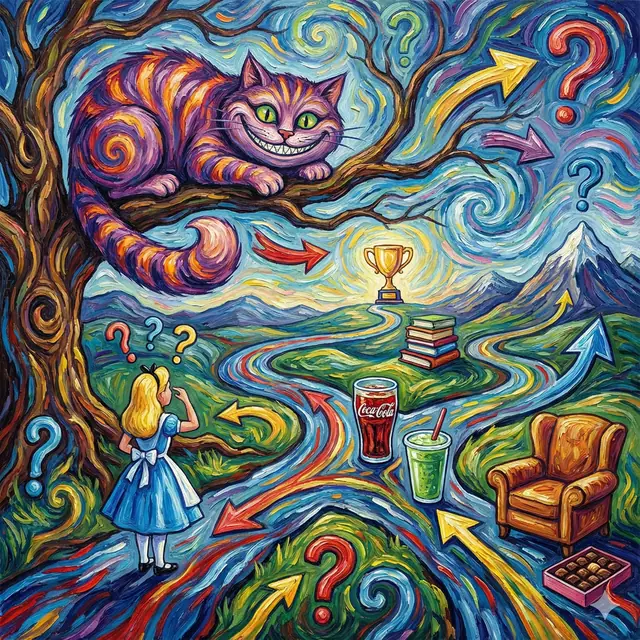
“Would you tell me, please, which way I ought to go from here?” “That depends a good deal on where you want to get to,” said the Cat. “I don't much care where—” said Alice. “Then it doesn't matter which way you go,” said the Cat. – Lewis Carroll, Alice's Adventures in Wonderland (1865)
Now that you have started to sniff out why you are here, we have to ask the next question.
What do you want?
The answer to that question is decisive for your development. Without a direction there is a considerable risk that you, just like Alice, will simply wander around without any goal or course. There is nothing wrong with that, but it will take longer to get to where you want to be.
But the question is tricky. Because “want” is not an unambiguous word.
Do you want to lose weight? Do you want to get stronger? Do you want to make a career? Do you want to become a professional footballer? Do you want to bake a cake? Do you want to go out and ski? Do you want to play a game on the computer? Do you want to read a book? Do you want to write a book? Do you want to burn a book? Or do you actually just want to lie on the sofa, eat pralines and be spared all the pressure?
The conflict within you
I am writing a book about wellbeing and personal development. You might think I sit here with a kale smoothie, meditating between paragraphs.
The truth? Right now I am sitting here drinking a glass of ice-cold Coca-Cola.
One part of me – my rational brain – wants a healthy body, good fitness and a long life. Another part of me – my reward-seeking brain – wants sugar and quick energy now, so that I can put up with this bloody business of writing a book.
This inner conflict is not a sign of weak character; it is biology. The psychologist and Nobel laureate Daniel Kahneman describes it as a struggle between two systems: the fast, impulsive system that seeks immediate gratification, and the slow, reflective system that plans for the future (Kahneman, 2011).
Knowing what you want is about choosing which voice to listen to and follow. Especially when many things are tempting you at the same time.
Goals vs. meaning
If you are here to move forward in your career, then it is work-related goals we should look at. If you are here to find joy, then it is a matter of meaningful activities.
But I want to warn you about getting stuck on goals. Goals are important, but they are finite. The American entrepreneur and author Seth Godin often points out that many people climb a ladder their whole lives, only to realise when they reach the top that the ladder was leaning against the wrong wall.
That is why we need to distinguish between what you want to achieve (goals) and how you want to live (values/direction).
Right now I want to finish writing this book. That is a goal. But why do I want it? Because I want to inspire and coach people. That is a direction. The book will be finished, but the wish to inspire never runs out, because it is the direction and the value that drive me forward.
Exercise
The three levels of wanting
Purpose: It is easy to say “I want…”, but what does it actually mean? In this exercise we sort your wanting into three levels, based on psychological research into motivation and goal-setting. When you separate these, it becomes easier to understand your own choices.
Level 1: Impulse wanting (what you want in the moment)
What is your body or your feelings craving right now? This is governed by our most primitive systems. It is the impulses that make us scroll on our phone instead of sleeping, or eat the cake we had decided to leave alone.
- Write down three things you want right now. Do not censor yourself.
- Examples: “I want to sleep.” / “I want sweets.” / “I want to avoid responsibility.”
Insight: Impulse wanting is neither wrong nor bad – it simply is. But you do not have to obey it.
Level 2: Goal wanting (what you want to achieve)
What do you want to happen in the future? This is where we bring in the prefrontal cortex. According to “Goal Setting Theory” (Locke & Latham, 2002), goals need to be specific and challenging in order to motivate us.
- Write down three concrete results you want to achieve.
- Examples: “I want to run ten kilometres in under 50 minutes.”
- Examples: “I want to change jobs within a year.”
Level 3: Direction wanting (what you want to stand for)
Who do you want to be along the way? These are your values. Unlike goals, these cannot be “ticked off”. They are a compass bearing. According to research within ACT, contact with one's values is decisive for mental health (Hayes et al., 2006).
- Write down a sentence about why you want to reach the goals in level 2.
- Example: “I want to look after my body so that I have the energy to play with my children.”
Closing reflection
Look at your answers. Is your impulse wanting in conflict with your goal wanting? (For example, “I want to rest” vs “I want to run ten kilometres”.) If so – which direction wanting could help you decide who wins the struggle today?
References (4)
- Carroll, L. (2015). Alice i Underlandet. (Original edition published 1865).
- Hayes, S. C., Luoma, J. B., Bond, F. W., Masuda, A., & Lillis, J. (2006). Acceptance and commitment therapy: Model, processes and outcomes. Behaviour Research and Therapy, 44(1), 1–25.
- Kahneman, D. (2011). Thinking, fast and slow. Farrar, Straus and Giroux.
- Locke, E. A., & Latham, G. P. (2002). Building a practically useful theory of goal setting and task motivation. American Psychologist, 57(9), 705–717.
Want the book in your hands?
The whole of Välmåendecoach can be read here. The printed, signed edition is also available — and it can be read on the sofa without a screen.
Formulating what you actually want is harder alone. That is exactly what coaching does.