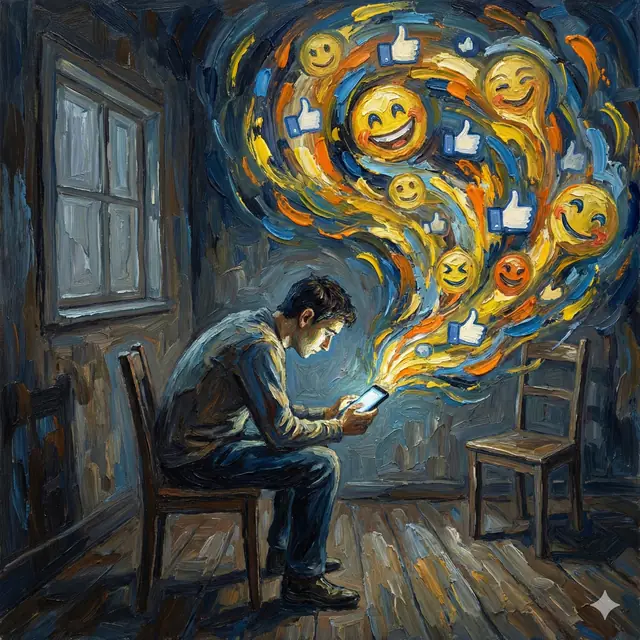
“Social media creates an illusion of connection, but often leaves us more isolated than ever in our search for validation.” – Dalai Lama
As an influencer I have chosen to share my life publicly. But in intense periods a strange paradox arises: it feels as if I do not exist if nobody sees what I am doing or where I am. My existence becomes dependent on an audience.
From a Buddhist perspective, this is an extremely self-centred – and painful – way to live. Buddhism speaks of Anatta, the idea that there is no fixed, permanent “self”. When we build our identity on social media, we do precisely the opposite: we create a statue of ourselves, a digital avatar that we must constantly polish and feed with likes. The problem is that the statue is never satisfied, and we become its slaves.
The algorithm as your architect
It is important to understand that social media is not designed to enrich your life. It is a set of commercial tools built to maximise your time on the platform. This happens through two powerful mechanisms:
- Doomscrolling: A behaviour that resembles an addiction. We constantly search for the next dopamine hit in a feed that never ends.
- The validation loop: The algorithm amplifies what you already like. If you seek validation for your appearance, you will see more people doing the same, which creates a distorted picture of reality in which comparison becomes unavoidable.
Research shows that frequent use of social media, particularly with a focus on social comparison, is strongly linked to an increased risk of depression and anxiety (Twenge et al., 2018).
When the biggest stars switch off the screen
Not even those with the most likes in the world are immune. Selena Gomez, who for a long time was the most followed person on Instagram, has openly spoken about deleting the app from her phone because it made her feel bad and inadequate. She realised that the digital mirror was showing an image she no longer recognised.
The actor Tom Holland took a similar break and described social media as “overstimulating” and “suffocating”. By logging out, they regained control over their own self-worth. They stopped measuring their success in algorithms and began measuring it in presence.
Reclaiming your digital everyday life
Social media is not all bad; it can build bridges and spread knowledge. But in order not to drown, radical awareness is needed. We have to ask ourselves: Why am I posting this? Is it to share a genuine experience, or to fill an inner void with external likes?
When we start asking these questions, we stop being passive consumers. We become conscious co-creators of our own mental climate. We begin to exist for our own sake, not for the screen's.
Exercise
Digital self-respect
Purpose: To develop a conscious approach to social media and reduce dependence on external validation. The method builds on principles from self-compassion (Neff, 2011) and digital minimalism.
Step 1 – The honest log
On an ordinary day, note the following each time you pick up your phone:
- The impulse: What did I feel just before opening the app? (Boredom, loneliness, stress?)
- The feeling in the meantime: Does the content give me energy, or do I feel a sting of envy or inadequacy?
- The aftertaste: How do I feel ten minutes after putting the phone down?
Step 2 – Self-compassion check
Identify the most common negative thought that comes up when you compare yourself with others online (e.g. “I am not as successful as...”).
- Write down what you would say to a friend who expressed exactly the same thing.
- Practise directing the same warmth towards yourself: “What I am seeing is an edited moment, not the whole truth. I am enough as I am.”
Step 3 – Social Detox Light
Choose a 24-hour period during which you abstain from social media altogether.
- Observation: Which situations trigger the urge to “check in”?
- Replacement: What do you do with the time that is freed up? (Read a book, go for a walk without a camera, have an uninterrupted conversation.)
Step 4 – Create your digital manifesto
Set up three personal rules for how you use your phone:
- Time: E.g. “No social media after 9 p.m.”.
- Content: E.g. “I unfollow accounts that make me feel inadequate”.
- Purpose: E.g. “I only post when I have something I genuinely want to share, not to seek validation”.
References (2)
- Neff, K. (2011). Self-compassion: The proven power of being kind to yourself. William Morrow.
- Twenge, J. M., Joiner, T. E., Rogers, M. L., & Martin, G. N. (2018). Increases in depressive symptoms, suicide-related outcomes, and suicide rates among U.S. adolescents after 2010 and links to increased new media screen time. Clinical Psychological Science, 6(1), 3–17.
Would you like the book in your hands?
The whole of Välmåendecoach can be read here. The printed, signed edition is also available – and it can be read on the sofa without a screen.
Screens and self-esteem is one of my most common talks for schools. Book a talk.