“A man is rich in proportion to the number of things which he can afford to let alone.” – Henry David Thoreau
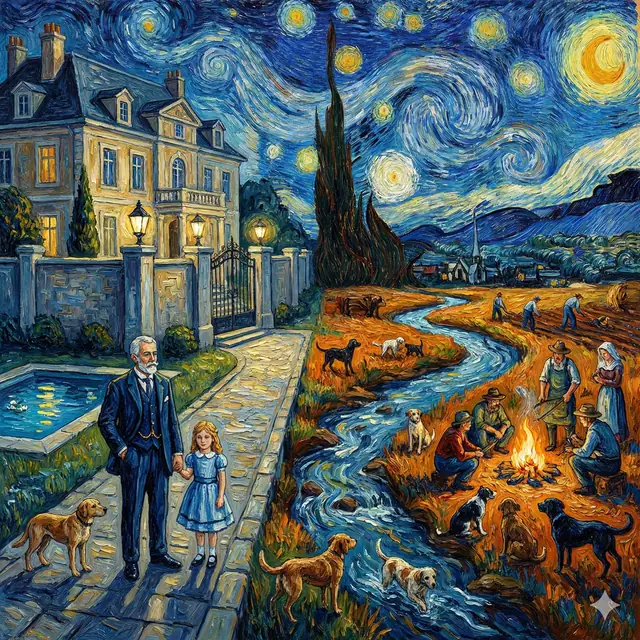
One day a wealthy father took his daughter on a trip to a remote rural area. The purpose was educational: he wanted to give her a “reality check” and show her how hard life can be without material possessions. He wanted her to see poverty up close, so that she would learn to appreciate their own privileged life.
When they got home, the father asked eagerly: “Well, what did you think of the trip? Did you see how poor they were?”
The daughter thought for a while and replied: “It was fantastic, Dad. I saw that we have only one dog, but they had four. We have a pool that reaches to the middle of the garden, but they had rivers that never ran out. We have imported lamps at night, but they had the stars. We buy our food, but they grow theirs. We have walls that protect us, but they have friends who protect them. We have TV and computers, but they have time to sit together.”
The father fell silent. The daughter had understood something fundamental: that wealth does not lie in what we own, but in what we are part of.
The economic threshold of happiness
We live in a culture where wealth is measured in square metres, brands and digital validation. But as biological beings, we are not built to find lasting happiness in things.
Research by the Nobel Prize winners Daniel Kahneman and Angus Deaton (2010) shows that there is a clear threshold for how much money affects our everyday wellbeing. In Sweden this threshold lies at around a monthly income that covers basic needs and provides a sense of security. Beyond that, every extra krona yields less and less in the form of happiness. What actually builds lasting wellbeing is instead social bonds, autonomy and a sense of meaning.
Inner Scorecard: Warren Buffett and José Mujica
The world's best-known investor, Warren Buffett, often talks about the importance of an “Inner Scorecard”. He argues that rich people often live by an outer system of grading – what others think of their car or house – while the truly successful live by an inner one. If you do something you know is good, but the world thinks it is bad, how do you feel then? The person who owns their own worth is the one who is truly rich.
Another extreme example is José Mujica, Uruguay's former president. Although he held the country's highest office, he refused to move into the presidential palace. He stayed on his small flower farm, drove an old Volkswagen Beetle and gave away 90 per cent of his salary. He said: “I am called the poorest president, but I do not feel poor. Poor people are those who just work to try to maintain an expensive lifestyle, and always want more and more” (Mujica, 2014).
The five true riches
Modern psychology, led by the famous Harvard study (the longest study of human happiness in history), points to five areas that create a “rich” life:
- Good relationships: The quality of our close bonds is the single most important factor for health and longevity.
- Meaning: Being part of something larger than yourself.
- Time in nature: Following biological rhythms lowers cortisol levels and helps to heal stress.
- Autonomy: The ability to direct your own time and choices.
- Altruism: Helping others activates the brain's reward system more powerfully than buying something for yourself.
Wealth is not about romanticising deprivation, but about questioning the consumer frenzy and seeing what truly nourishes the soul.
Exercise
What is my wealth?
Purpose: To shift focus from external attributes to inner and social factors that build subjective wellbeing (Seligman, 2011).
Step 1 – Take stock of your inner wealth
Answer the following questions honestly for yourself:
- Which three relationships in your life give you the most energy and security?
- Which activity makes you lose track of time and place (flow)?
- When did you last feel genuinely “rich”, regardless of money?
Step 2 – Analyse the empty calories
Identify something in your life that you spend a lot of time or money on, but which does not really make you happier.
- Is it a status symbol?
- Is it a subscription you don't use?
- Is it time on social media where you only compare yourself with others?
Step 3 – Reinvest in your capital
Choose one concrete action to strengthen your true wealth today:
- Relationship: Call or visit someone without an agenda, just to listen.
- Nature: Go out into the forest or a park for 20 minutes without your phone.
- Meaning: Do a small favour for someone else without telling anyone about it.
Step 4 – The gratitude log
Write down three things every evening that you are grateful for. Research by Sonja Lyubomirsky (2007) shows that this simple practice can raise your baseline level of happiness in just a few weeks.
References (4)
- Kahneman, D., & Deaton, A. (2010). High income improves evaluation of life but not emotional well-being. Proceedings of the National Academy of Sciences, 107(38), 16489–16493.
- Lyubomirsky, S. (2007). The how of happiness: A scientific approach to getting the life you want. Penguin Press.
- Seligman, M. E. P. (2011). Flourish: A visionary new understanding of happiness and well-being. Free Press.
- Waldinger, R., & Schulz, M. (2023). The good life: Lessons from the world's longest scientific study of happiness. Simon & Schuster.
Would you like the book in your hands?
The whole of Välmåendecoach can be read here. The printed, signed edition is also available – and it can be read on the sofa without a screen.
What wealth means is a question worth a conversation. Here is how coaching works.