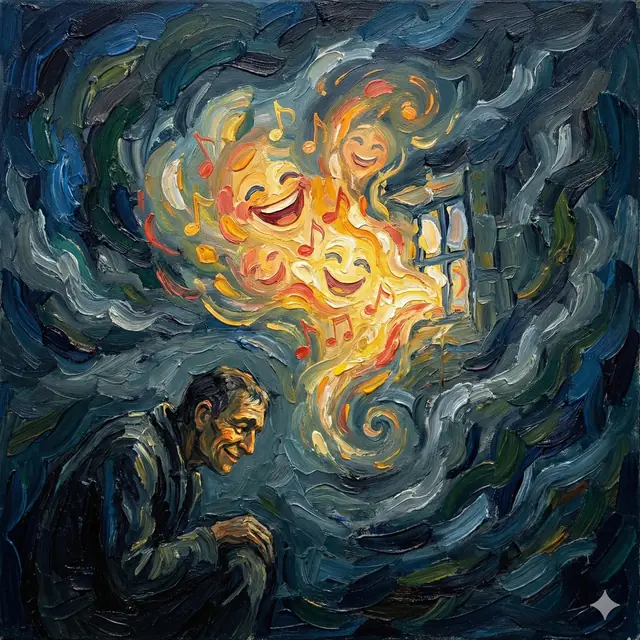
“Humour was another of the soul's weapons in the fight for self-preservation.” – Viktor Frankl
There are moments in life when laughter bubbles up as a pure reflex, not because the situation is funny, but because it is too hard to take in. I have experienced it several times: I tell of a painful experience and hear myself laughing, as if humour could lighten the weight.
To an outsider this may seem out of place, perhaps even inappropriate. But this ‘nervous laughter’ is an ancient, biological strategy for managing to bear what is difficult. Humour works as a valve; a way of letting out the inner pressure before the container bursts.
Norman Cousins and the Anatomy of Laughter
Many of us use humour intuitively, but it is also medicine. One of the best-known examples is the journalist Norman Cousins. In the 1960s he was struck by a severe spinal disease and was told he had a minimal chance of survival. Instead of giving up, he checked into a hotel room, where he prescribed himself a course of vitamin C and Marx Brothers films.
He discovered that ten minutes of belly laughter gave him two hours of pain-free sleep. Cousins quite literally laughed his way back to life, and showed that positive emotions have a direct biochemical effect on healing (Cousins, 1979). Research today confirms what Cousins sensed: laughter lowers levels of the stress hormone cortisol and releases endorphins.
David Letterman: Humour as a Bridge over the Unthinkable
Sometimes humour is not about healing the body, but about healing an entire society. After the terrorist attacks of 11 September 2001, the world came to a standstill. The entertainment industry fell silent. Nobody knew whether it would ever be all right to laugh again.
The first comedian to return to the screen was David Letterman. He walked out on stage, with no script and no jokes, and spoke straight from the heart about his despair. But by simply standing there, and eventually daring to invite a small, tentative smile, he broke the ice.
Letterman showed that humour need not be disrespectful. Quite the opposite. By bringing back everyday life and the absurdity of life, he created a space for both reconciliation and togetherness. Humour became a bridge over the unthinkable, a way for an entire nation to breathe out and recognise that life has to go on (Zinoman, 2017).
Gallows Humour in the Dark
There is a particular kind of humour that thrives in the darkest of environments: gallows humour. Viktor Frankl, psychiatrist and Auschwitz survivor, described how humour was essential to life even in the concentration camp. He and his fellow prisoners joked about the absurdity of their situation in order to build a mental barrier between themselves and the horrors. It was a way of saying: “You can take my freedom, but you cannot take my ability to choose how I respond” (Frankl, 1984).
Cognitive Reframing and the Tragicomic
I often see the world as a tragicomic stage. We humans struggle, strive and fail constantly. Being able to laugh at our own shortcomings is not to deny them – it is to acknowledge our humanity.
Humour is a tool for cognitive reframing. When we laugh at a problem, we are forced to see it from a new angle. What was just frightening suddenly becomes manageable, perhaps even a little ridiculous. Humour breaks the automatic thought patterns of worry and switches on a light in the dark room. The monster under the bed may not disappear, but we can see that it is only a dust bunny.
It is not always appropriate to laugh. At a funeral or in a deep crisis, stillness may be the only answer. But to shut humour out completely is to miss one of our most powerful resources.
Exercise
Humour Log – Training Joy
Purpose: To use humour deliberately as a resilience tool to reduce stress and create new perspectives on setbacks (Martin, 2007).
Step 1 – The Hunt for Laughter
For one week, keep a simple log of moments when humour played a part in your day. Note at least one thing per day:
- Example: An in-joke with a colleague, a funny video you saw, or a moment when you laughed at your own clumsiness.
Step 2 – Humorous Reinterpretation (Reframing)
Choose a situation from the week that felt heavy, irritating or embarrassing. Try to rewrite the event as if it were a scene in a sitcom or a stand-up routine.
- Reality: “I spilt coffee all over my white shirt just before the pay review.”
- Thought (Stress): “I'm an idiot, now I won't get the raise.”
- Reinterpretation (Humour): “That was a strategic move. Now I look so worn out and desperate that the boss has to give me a raise out of sheer pity. It was my audition for the role of ‘Living Coffee Filter’.”
Research shows that this kind of reinterpretation effectively reduces the intensity of negative emotions (Gross, 2002).
Step 3 – Shared Laughter
Plan an occasion this week when you seek out shared laughter. Laughter is a social glue that signals safety (Dunbar, 2012).
- Call the friend who always makes you laugh.
- Watch a comedy special together with your partner, without phones.
Reflection at the End of the Week
Has your view of ‘failures’ changed now that you look for the comic in them? Humour does not remove the problem, but it makes it considerably easier to bear.
References (6)
- Cousins, N. (1979). Anatomy of an illness as perceived by the patient. W.W. Norton & Company.
- Dunbar, R. I. M. (2012). The social role of laughter and humor. Evolutionary Psychology, 10(5), 147470491201000512.
- Frankl, V. E. (1984). Man's search for meaning: An introduction to logotherapy. Simon & Schuster. (Original work published 1946).
- Gross, J. J. (2002). Emotion regulation: Affective, cognitive, and social consequences. Psychophysiology, 39(3), 281–291.
- Martin, R. A. (2007). The psychology of humor: An integrative approach. Elsevier Academic Press.
- Zinoman, J. (2017). Letterman: The last giant of late night. Harper.
Want the book in your hands?
The whole of Välmåendecoach is available to read here. A printed, signed edition is also available – and it can be read on the sofa without a screen.
Humour as a shield is also something to take a closer look at. How coaching works.